Creative Adventures - podcast and Substack newsletter logo
The existential importance of being bored -  - an essay by @stevexoh

The existential importance of being bored
by Steve Xoh

My relationship with time seems to have shifted in 2026. As I look back over the last few years, my enduring memories are of moments where time dragged and of desperately finding ways to kill it. This wasn’t all the time. There were, of course, moments of immersion and flow, in which I would be so absorbed and fascinated that the passing of minutes and hours didn’t even register as a conscious thought. But they seemed to be becoming more fleeting and precious, so much so that I found myself trying to seek them out or manufacture them, which I soon learned is a guaranteed way to make them not happen. I’ve always thought that you can’t consciously enter flow, just as you can’t know you’ve been in flow until you’re no longer there. The very act of pausing, noticing and saying to myself “Oh, I’m in flow” means that I’m already out of it.

My best selling T-shirt is one with an ominous blue cat emblazoned with the words “I AM VERY BORED.” I made this painting in one of those restless moments where I found myself sitting in my studio, terribly bored and trying to find ways to kill time and make the day pass more quickly. Inspired by the Buddhist philosophy that “the obstacle is the path” I decided that rather than try to escape my boredom, I should love it so much that I paint it. Two hours later I realised that by moving towards my boredom I had transformed it into a wonderful creative flow state and accidentally come up with a great T-shirt design.

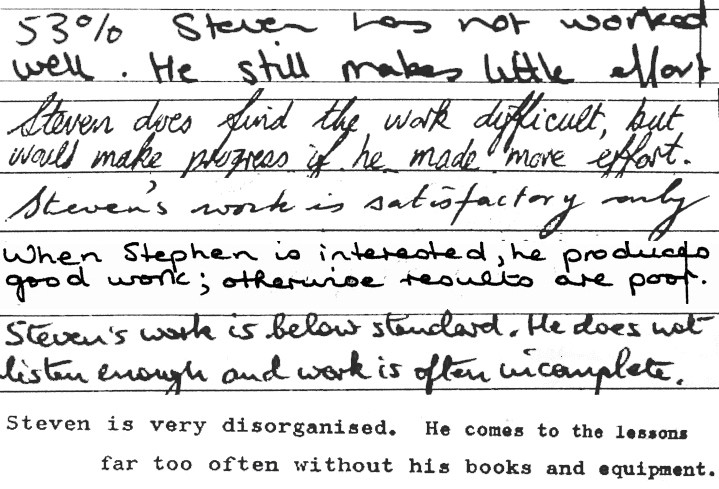
I have had a close relationship with boredom since I was a kid. I think it all started at secondary school, when I suddenly found myself in situations where I genuinely had no interest or fascination in the experience. Prior to this, I had always found ways to let my imagination run wild. At primary school I had been rewarded for such creativity, but secondary school was a totally different experience. I would try really hard to be a good student and concentrate and do my best, but I found it impossible to manufacture interest on demand. A few years ago I was rooting through my parents’ loft and found an old school report from when I was about 14 or 15 years old. I found it fascinating to read.

I remember cringing on report days, knowing that, other than maybe an B for effort in art, it wouldn’t be a glowing appraisal of my abilities. My parents wanted the best for me and would conclude from these remarks that I just wasn’t trying hard enough, even though my experience was that I was absolutely doing the best I could. It was only when I re-read these reports later in life that I realised that, for the vast majority of the seven years I was at secondary school, I was totally and utterly bored.

I’m fascinated by boredom and why it’s regarded as such a negative thing. I find it strange that, in school at least, the responsibility for managing it seems to be placed solely on the student. And why is saying “I am bored” as an adult such a taboo, or regarded as rude or childish? At least as an adult I have more agency to remove myself from situations in which I feel bored. At school this wasn’t an option. If I followed my instincts and did something different, like doodling or getting up to leave the classroom, I would be told that my lack of interest was putting my entire future in jeopardy.

The only bits of school I remember being interesting were the bits in between lessons. I remember creating a school radio station in a cupboard with my friends, a great idea until we realised that we wouldn’t be able to broadcast much because we had to be in lessons. I remember making a swing out of a chair and some rope tied to a support beam, and pushing a friend on it so high that his feet went through the polystyrene ceiling tiles. Occasionally a lesson would become momentarily interesting, like the time in an A-level law lesson when a budgie flew into the classroom through an open window. (It is a long story as to why I ended up accidentally doing A-level law. The summary being that it didn’t turn out to be as exciting as I had imagined and I graduated with a grade U.)

The German philosopher Martin Heidegger coined the term Dasein to describe the human way of existing - a form of life that knows it exists and relates to the world as something to be fully lived and in which meaning can arise. Heidegger explored the concept of boredom through the lens of Dasein and suggested that it is an experience in which our relationship with time alters. When we are absorbed in flow, finding meaning in the here and now, time is no longer at the forefront of our experience but quietly recedes into the shadows. But when we experience boredom, time becomes loud and visible. It becomes figural in our awareness, pulling focus away from our here and now experience. This shift in attention causes us to experience time as faltering, suffocating and devoid of meaning, as if the mysteries of the world have suddenly stopped offering themselves to us.

I’m not a fan of our human obsession with purpose. I don’t understand why it feels so important to try and pin down and define something that feels much more exciting when allowed to remain open and amorphous. I find it far more helpful to pay attention to meaning. When I find meaning in something, I feel in a state of flow, fully present and fulfilled. My relationship with time feels symbiotic, and I experience a sense of synchronicity and connection within myself and with my environment. The concept of purpose feels like it excludes more than it defines. Focusing on purpose means we may not notice the wonderful invitations to make meaning that dance on the edges of our awareness. I have found as much meaning in moments of creating art, writing this Substack and being a parent as I have in watching the waves, learning about eels or tidying my flat.

I have found more of those moments of meaning in the first month of 2026 than usual. Moments when I suddenly realise hours have passed because I have been so absorbed in something. What I find fascinating is that nothing has really changed externally - I live in the same flat, participate in the same activities, visit the same places. And while I still have moments of boredom, or feel restless and frustrated, I realise that these are moments when my relationship with time has shifted for reasons that are, in themselves, fascinating and worthy of reflection.

This essay was originally published on Substack. You can listen to the podcast in which Steve talks about this essay via the listening links below.

The existential importance of being bored
by Steve Xoh

My relationship with time seems to have shifted in 2026. As I look back over the last few years, my enduring memories are of moments where time dragged and of desperately finding ways to kill it. This wasn’t all the time. There were, of course, moments of immersion and flow, in which I would be so absorbed and fascinated that the passing of minutes and hours didn’t even register as a conscious thought. But they seemed to be becoming more fleeting and precious, so much so that I found myself trying to seek them out or manufacture them, which I soon learned is a guaranteed way to make them not happen. I’ve always thought that you can’t consciously enter flow, just as you can’t know you’ve been in flow until you’re no longer there. The very act of pausing, noticing and saying to myself “Oh, I’m in flow” means that I’m already out of it.

My best selling T-shirt is one with an ominous blue cat emblazoned with the words “I AM VERY BORED.” I made this painting in one of those restless moments where I found myself sitting in my studio, terribly bored and trying to find ways to kill time and make the day pass more quickly. Inspired by the Buddhist philosophy that “the obstacle is the path” I decided that rather than try to escape my boredom, I should love it so much that I paint it. Two hours later I realised that by moving towards my boredom I had transformed it into a wonderful creative flow state and accidentally come up with a great T-shirt design.

I have had a close relationship with boredom since I was a kid. I think it all started at secondary school, when I suddenly found myself in situations where I genuinely had no interest or fascination in the experience. Prior to this, I had always found ways to let my imagination run wild. At primary school I had been rewarded for such creativity, but secondary school was a totally different experience. I would try really hard to be a good student and concentrate and do my best, but I found it impossible to manufacture interest on demand. A few years ago I was rooting through my parents’ loft and found an old school report from when I was about 14 or 15 years old. I found it fascinating to read.

I remember cringing on report days, knowing that, other than maybe an B for effort in art, it wouldn’t be a glowing appraisal of my abilities. My parents wanted the best for me and would conclude from these remarks that I just wasn’t trying hard enough, even though my experience was that I was absolutely doing the best I could. It was only when I re-read these reports later in life that I realised that, for the vast majority of the seven years I was at secondary school, I was totally and utterly bored.

I’m fascinated by boredom and why it’s regarded as such a negative thing. I find it strange that, in school at least, the responsibility for managing it seems to be placed solely on the student. And why is saying “I am bored” as an adult such a taboo, or regarded as rude or childish? At least as an adult I have more agency to remove myself from situations in which I feel bored. At school this wasn’t an option. If I followed my instincts and did something different, like doodling or getting up to leave the classroom, I would be told that my lack of interest was putting my entire future in jeopardy.

The only bits of school I remember being interesting were the bits in between lessons. I remember creating a school radio station in a cupboard with my friends, a great idea until we realised that we wouldn’t be able to broadcast much because we had to be in lessons. I remember making a swing out of a chair and some rope tied to a support beam, and pushing a friend on it so high that his feet went through the polystyrene ceiling tiles. Occasionally a lesson would become momentarily interesting, like the time in an A-level law lesson when a budgie flew into the classroom through an open window. (It is a long story as to why I ended up accidentally doing A-level law. The summary being that it didn’t turn out to be as exciting as I had imagined and I graduated with a grade U.)

The German philosopher Martin Heidegger coined the term Dasein to describe the human way of existing - a form of life that knows it exists and relates to the world as something to be fully lived and in which meaning can arise. Heidegger explored the concept of boredom through the lens of Dasein and suggested that it is an experience in which our relationship with time alters. When we are absorbed in flow, finding meaning in the here and now, time is no longer at the forefront of our experience but quietly recedes into the shadows. But when we experience boredom, time becomes loud and visible. It becomes figural in our awareness, pulling focus away from our here and now experience. This shift in attention causes us to experience time as faltering, suffocating and devoid of meaning, as if the mysteries of the world have suddenly stopped offering themselves to us.

I’m not a fan of our human obsession with purpose. I don’t understand why it feels so important to try and pin down and define something that feels much more exciting when allowed to remain open and amorphous. I find it far more helpful to pay attention to meaning. When I find meaning in something, I feel in a state of flow, fully present and fulfilled. My relationship with time feels symbiotic, and I experience a sense of synchronicity and connection within myself and with my environment. The concept of purpose feels like it excludes more than it defines. Focusing on purpose means we may not notice the wonderful invitations to make meaning that dance on the edges of our awareness. I have found as much meaning in moments of creating art, writing this Substack and being a parent as I have in watching the waves, learning about eels or tidying my flat.

I have found more of those moments of meaning in the first month of 2026 than usual. Moments when I suddenly realise hours have passed because I have been so absorbed in something. What I find fascinating is that nothing has really changed externally - I live in the same flat, participate in the same activities, visit the same places. And while I still have moments of boredom, or feel restless and frustrated, I realise that these are moments when my relationship with time has shifted for reasons that are, in themselves, fascinating and worthy of reflection.

This essay was originally published on Substack. You can listen to the podcast in which Steve talks about this essay via the listening links below.

(C) Stevexoh 2025