I decided a few months back that I didn’t want to do anything special to mark the tenth edition of this my Substack/podcast. For a moment I considered doing something different with the format, maybe asking readers /listenerswhat they would like in it, or speaking about how it has been to produce these long-form pieces over the last ten months. But within seconds of coming up with these ideas, I realised that I hated them because they were way too obvious. (Not Keith Johnstone’s definition of obvious, which relates to uncensored spontaneous self-expression, but the definition that is more aligned with common sense, cultural trends and what everyone else would do!)
I got a bit annoyed with myself for even feeling that issue number ten was significant. It is just another number and another piece of writing that I am doing because I love getting lost in the process of following abstract chains of thought. I started to wonder why ten feels so significant anyway and decided to try to find out more about why this progression from single digits to double digits feels meaningful to humans.
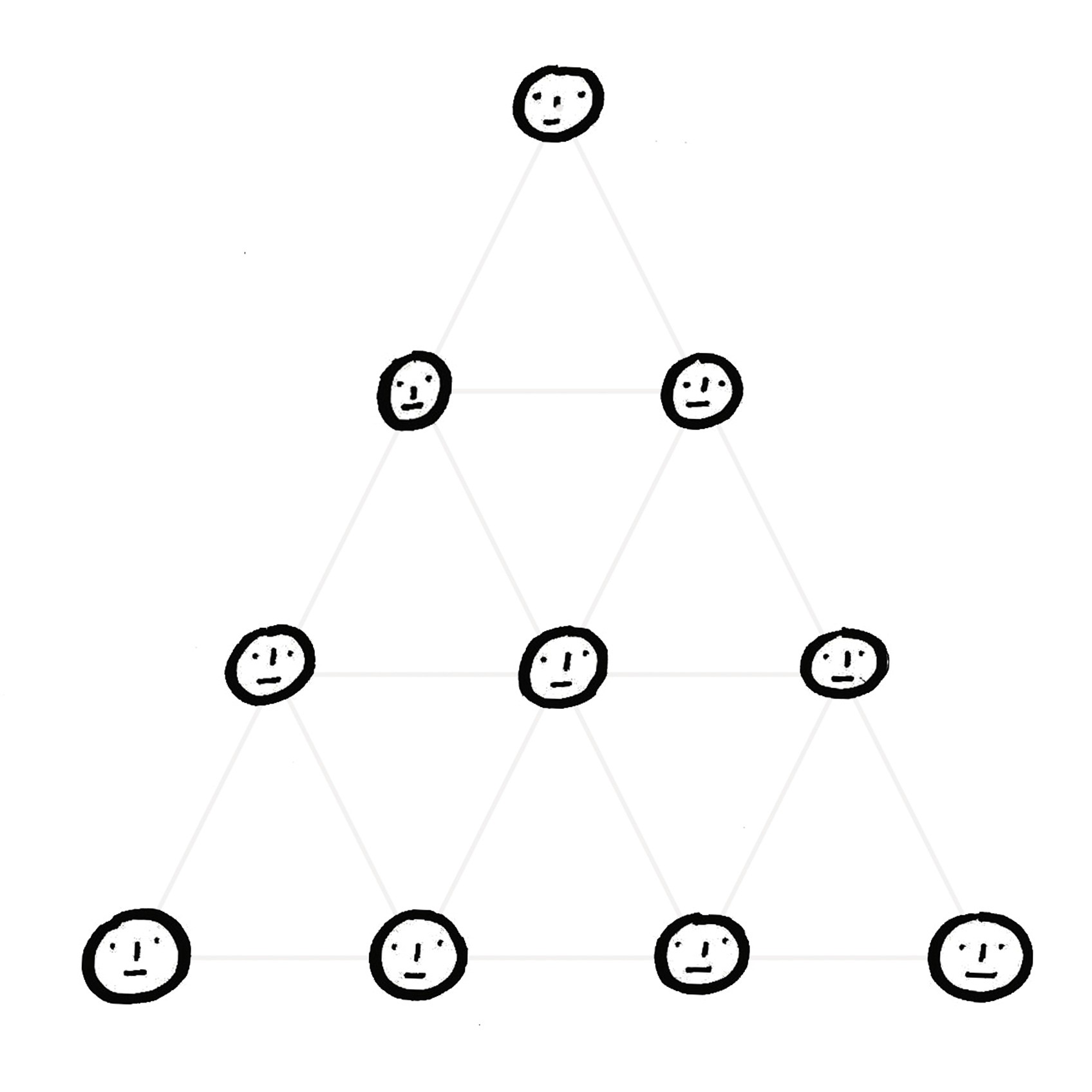
The most obvious explanation I came across is that ten feels important simply because we have ten fingers. From the earliest days of human history the number ten has likely felt meaningful even before language fully developed. And then, as language and concepts such as mathematics and science emerged, the number ten took on even more significance. The Pythagoreans believed that ten was the most perfect number and revered a geometric shape called the Tetractys, which arranged the first four numbers (1, 2, 3, 4) in rows that not only added up to ten but made a really cool triangle shape. The Pythagoreans loved this idea so much that they believed the number ten and the Tetractys contained the entire structure of reality and represented proportional balance, the hidden structure of the cosmos. (To be fair, it’s as good as any other theory I’ve heard.)
As society has evolved, so has our interest in the significance of ten. A 2014 scientific paper published in the Proceedings of the National Academy of Sciences (PNAS) suggests that existential reflection increases for humans near decade boundaries of age (i.e. 29, 39, 49 etc). And whilst the process of ageing and experiencing time is continuous, the cognitive experience of approaching a new decade signals a boundary that we simultaneously treat like an ending and a beginning, prompting a moment of life evaluation. We can experience it as the metaphorical conclusion of one chapter and the start of another. Or, to adopt a more modern metaphor, the number nine is like the end-of-level boss in a computer game that we must work out how to defeat before progressing to the next level.
A Threshold Guardian is an archetype that appears in human storytelling throughout the ages. We find threshold guardians in folklore, myths, legends, and more recently in books and films. A threshold guardian is a being or an obstacle that stands between the protagonist’s present reality and whatever lies beyond. Often the threshold guardian tests the hero’s resolve and readiness for the next stage of the adventure, forcing them to dig deeper than they have before in order to defeat or overcome it. In Greek mythology the three-headed dog Cerberus guards the entrance to the underworld, preventing the living from entering and the dead from leaving. In many folktales (and children’s stories) a troll guards a bridge and demands a toll or sets a challenge before people can pass to the other side. And in one of the most memorable scenes in The Lord of the Rings films the Balrog blocks the heroes’ escape from Moria across the Bridge of Khazad-dûm
I like the idea that the progression from 9 to 10 feels significant and worthy of ceremony or celebration because, at some level, we experience it as facing and overcoming a temporal threshold guardian. And having crossed that threshold, we find ourselves in a new realm of experience where the potential for novelty, difference and adventure feels much richer.
So maybe that’s why I couldn’t help but think about marking the occasion of issue 10, even though I really didn’t want to, because it felt a bit too meh!
(And I of course now realise that by writing all of this about not wanting to do anything significant to mark issue/episode ten, I accidentally have.)

 Apple
Apple Spotify
 Pocket casts
 Youtube
 Audible
 Substack