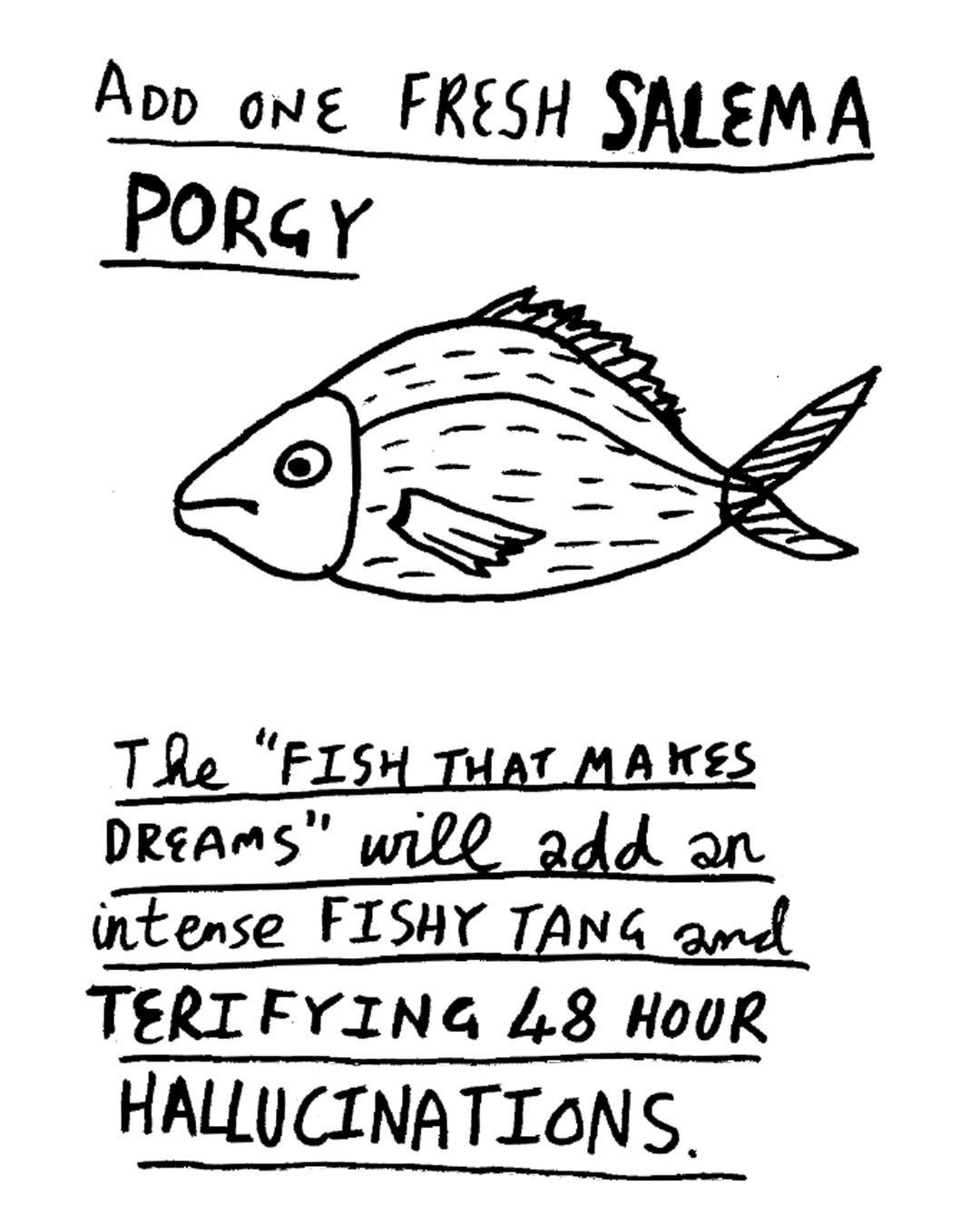
I recently learnt some weird facts about a common and unremarkable looking little Mediterranean fish. The fish is a salema porgy, one I recall seeing often in my scuba diving days. They were such a common sight when I dived in warmer waters that I ended up mentally categorising them as some kind of underwater pigeon - so common that they just become part of the background in a way that I no longer paid them much attention. (To be clear, I love pigeons. And salema porgy!)
On the few occasions when I managed to snorkel in Alonisos I saw big shoals of them and decided that they deserved as much of my curiosity as the other rarer species. As I had lots of time sitting in my room feeling ill and utterly bored I did a bit of research and it was when I typed salema porgy into a search engine that the weird and fascinating rabbit hole began to open up.
I learnt that in Arabic these little fish are known as “the fish that makes dreams” due to their hallucinogenic properties. I went on to read that salema porgy (latin name sarpa salpa) were consumed as a recreational drug in Roman times and used by Polynesians for ceremonial purposes. (I gleaned much of this information from this wonderful article in Atlas Obscura.)
But the bit that really grabbed my attention was an account from the Clinical Toxicology Journal about somebody who ate one of these fish in 1994:
“A 40-year-old man felt nauseated about two hours after enjoying fresh baked sarpa salpa on his vacation on the French Riviera. With symptoms like blurred vision, muscle weakness and vomiting persisting and worsening throughout the next day, he cut his vacation short and hopped in the car, only to realise mid-journey that he couldn’t drive with all the screaming animals distracting him. These giant arthropods—mere hallucinations, of course—were the last straw. The man directed himself to a hospital, where he recovered completely after 36 hours. He couldn’t recall a thing.”
There are other stories of people experiencing terrifying hallucinations, all of which seem to involve screaming creatures of some kind. But it seems nobody knows quite why eating salema porgy effects some people and not others making consuming them a bit of an alarming lottery. The freaky fish rabbit hole continued to open up as I looked up other weird effects seafood can have on humans. I learnt that ciguatoxin, sometimes found in reef fish like Baracuda, can cause a type of poisoning with strange effects such as phantom feelings, weeks of mood disturbances and the phenomena of hot/cold sensations being reversed! I also learnt that amnesic Shellfish Poisoning can cause short term memory loss.
Whilst I appreciate these are rare cases and eating sea creatures is generally safe, reading all of this made me extra glad that I am vegetarian as I am somewhat terrified of something like that happening to me. I think it is one of the deepest fears that I have - experiencing a sudden, unexplained change in my perception and thinking I am going crazy and not knowing why. I think I’ve had this fear since I was a child but it was certainly exaggerated by the Syd Barrett/LSD experience I referred to earlier, where I took too much LSD and temporarily “broke my brain”. (I told the full story about this onstage for One Track Minds at Wilton’s Music Hall back in 2019 which you can listen to here.) It was a very scary time not knowing if and when the experience of feeling so mentally broken and paranoid would end. I think it lasted for a few weeks but felt like a lot longer. However, the fascinating thing about this episode of temporary insanity was that it all ended when I had a strange dream.
The contents of the dream are somewhat irrelevant and I don’t know if I could explain them or even remember exactly what happened. But what I remember was having the dream, waking up suddenly with my body full of adrenaline, feeling like something significant had occurred and then noticing that my cognition and perception had dramatically returned to normal. I can only conclude that whatever happened in the dream was my body and brain’s way of processing or experiencing or synthesising something that I couldn’t do consciously in order to restore some sort of healthy balance.
I had a similar dream experience recently. Not related to LSD, which I have not been anywhere near since that incident. But related to some stuff I had been perpetually finding hard in my day to day life - feelings, thoughts and anxieties that felt old and unresolved and manifested in a number of difficult ways. I woke from this recent dream in a much more dramatic way. My body was in deep fight or flight and I genuinely felt like something terrible had happened to me. This feeling stayed with me for a couple of days and only started to dissipate when I wrote the dream down and started to tell others about it. Unusually for me I remembered a lot of the detail of the dream which meant I could reflect on it more deeply. I did drawings from it and wrote down all of the different elements of it - the dialogue, the locations, the characters, the symbols and metaphors. And the more I did this, the more those previously difficult feelings and thoughts dissolved or resolved in some way. I started to realise what I had initially experienced as a very disturbing dream might have been an important cognitive intervention.
Gestalt psychology talks about disorders arising from incomplete gestalts - previous experiences (often from childhood) in which our needs were unmet in such a way that their incompleteness sits undigested in our psyche. These incomplete gestalts can manifest in all sorts of psychological and physical ways and whilst they may resolve themselves naturally, often we need gestalt or other forms of therapy to help process them. So I can only think that this horrible dream was my brain doing the work needed in order to help complete these gestalts and resolve something within me. But beyond this hypotheses I have little understanding of what happened and why it seems to have helped so much. Nor do I really need to.
I experience a similar thing when working 1:1 with others using art, metaphor and rich pictures. I often invite people to make sense of things they are grappling with non-verbally by making marks on a page or paint on a canvas or by squishing a bit of clay or by making a movement. This way of working is an important part of the inner critic workshops I co-facilitate with Simon Cavicchia in which we support others in making sense of and integrating elements of our self-critical super ego. Often in this work somebody will create something and be utterly transformed by it. I’ve seen people sit back and say “Wow! That makes so much sense” or “This changes everything” and all I can see on the page is a series of blobs, lines, squiggles and symbols. The point is that it only needs to make sense to them and sometimes they don’t even know why it has helped.
I’ve started to appreciate that REM sleep must serve a similar function in re-experiencing, integrating, processing, synthesising and resolving sometimes problematic stuff out of conscious awareness. There’s a number of strands of neuroscience research that suggest that during REM sleep the brain replays emotionally charged experiences in a neuro-chemical environment that feels more safe and secure than waking consciousness. In the paper Overnight therapy? The Role of Sleep in Emotional Brain Processing the authors suggest that “REM provides an optimal biological theatre, within which, can be achieved a form of affective ‘therapy’.”
I wonder how many dreams I have had that have done this important work but I have totally forgotten them. And does it really matter that I have forgotten them if the work they needed to do has already been done? I also wonder the the same things about making therapeutic art - does it really need to make sense to anyone other than the artist? And does it even need to make sense to them? In my experience, the point of therapeutic art is the process and not the finished thing.
Arnie Biesser’s paradoxical theory of change has been a big influence on my work. It basically says that we change more through deepening awareness of who we already are rather than striving to be something we are not. What I love about this concept is that it means that there is never any homework to do or actions to complete - the work has been done through the experience itself.
We don’t need to hand in our dreams for marking any more than we need others to evaluate or understand our art. It is just for us, even if we don’t fully understand it.

 Apple
Apple Spotify
 Pocket casts
 Youtube
 Audible
 Substack