I found myself tumbling down a fascinating eel rabbit hole recently and realised how much I love these experiences: rare moments when something spontaneously piques my interest so deeply that I can’t help but seek out more information to satisfy a particularly strong flavour of curiosity. I think I’ve been like this since I was a kid and I remember being obsessively into things as diverse as sharks and London buses at different ages. More recently, I’ve noticed that these fascinations tend to focus on creatures, usually ones that are misunderstood, shrouded in mystery, or just very, very weird.
I’ve always found eels interesting. I have a vivid memory of going fishing with my dad as a child, watching him accidentally catch one and seeing it wriggle and wrap itself around his hand as he tried to get it off the hook. I also remember my mind being blown later in life by discovering that all European Eels, the ones we find in UK rivers, are born in the Sargasso Sea - a strange expanse of water in the North Atlantic. But although I was interested, this information alone wasn’t enough to ignite an obsession. That changed when I started reading Late Light by Michael Malay, a book I’d been given because of my interest in creatures. Reading isn’t my forte for many reasons, but I found myself enjoying the first chapter in which Malay describes coming to the UK and becoming fascinated by things I take for granted having lived here all my life: species of trees, indigenous birds, cultural customs, and so on. But when he mentioned that the subsequent chapters would be dedicated to four creatures he’d become obsessed with, another part of my brain came online.
The first of these chapters was simply entitled ‘Eels’. Seeing it written in bold in the middle of the page made me realise that I even love the way the word eel looks, as it resembles a creature in its own right. But it was reading Michael’s accounts of waiting at the mouth of the River Severn, at night, for the glass eels to arrive from the Sargasso Sea that I became captivated. He went on to explain that these juvenile eels arrive with no predetermined biological sex and that it is only decided once they reach fresh water and spend time in their new habitat.
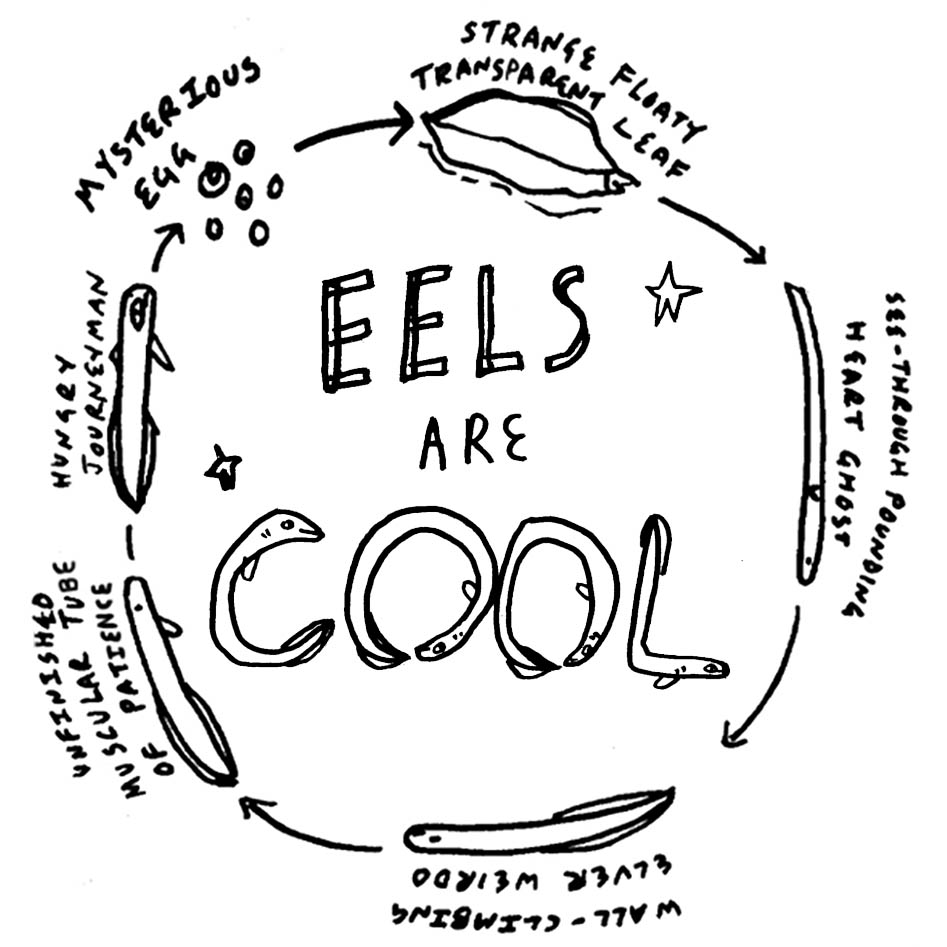
But the bit that really hooked me, like an eel, was learning that nobody knows where eels come from. Nobody has ever witnessed an eel mating. They simply drift up from the depths as weird, translucent, leaf-shaped organisms, emerging from the same dark and mysterious place that the adult silver eels descend to in order to mate and then die. (Having completed a 3,000-mile journey, metabolising their own bodies after giving up eating once they reached maturity!)
I love the mystery of eels. I especially love that with all of our human knowledge, technology and communication that we still don’t know where these little snake-like fish come from. It feels important to me to maintain an element of mystery in my life. To allow things to be unknown, unfinished and unresolved - including my knowledge of myself. For me it feels imperative that I remain somewhat of a mystery to me, even though this can be frustrating or overwhelming at times.
Mystery gives birth to wonder in the same way that the dark depths of the Sargasso Sea gives birth to eels. We don’t know how or why they float up from the darkness, but they do.
(I made a little zine entitled “Eels are cool” containing some of these facts.)

 Apple
Apple Spotify
 Pocket casts
 Youtube
 Audible
 Substack