The festive season is just one example of giving myself a hard time for finding things challenging. I mean, it is just another few days on the calendar and I have no religion, so it is of no particular spiritual significance to me personally. But I still feel an immense pressure to be a certain way that I don’t feel at other times and this just adds to my downward spiral. I wrote in the last edition of this Substack about a similar pressure I put on myself when going to an event or a social occasion. A self-imposed pressure to be a certain way. A blueprint of how I should be, which I critically compare to how I actually am, leaving me feeling terrible because I never live up to this unattainable standard.
Over the last 10 years, gestalt psychotherapist Simon Cavicchia and I have been working together to research and experiment with alternative ways of getting to know and work with the super-ego, the self-limiting and self-judging internal voice of authority that we often refer to as the Inner Critic. We have been fascinated by developing creative, embodied, and playful ways to better understand our unique Inner Critics, in order to learn to dance rather than battle with them. One of the psychic structures we invite workshop participants to pay attention to is that of idealised self-images or what Freud called ego ideals. Simon suggests that a simple way of thinking about the work of the Inner Critic is that it compares our lived experience of who we are and what we do with an idealised self-image, an unattainable blueprint of what we believe we should be like. These idealised self-images are stitched together from the past voices of parents, key care givers, teachers and other significant authority figures as well as the dominant societal narratives we encounter on a day to day basis.
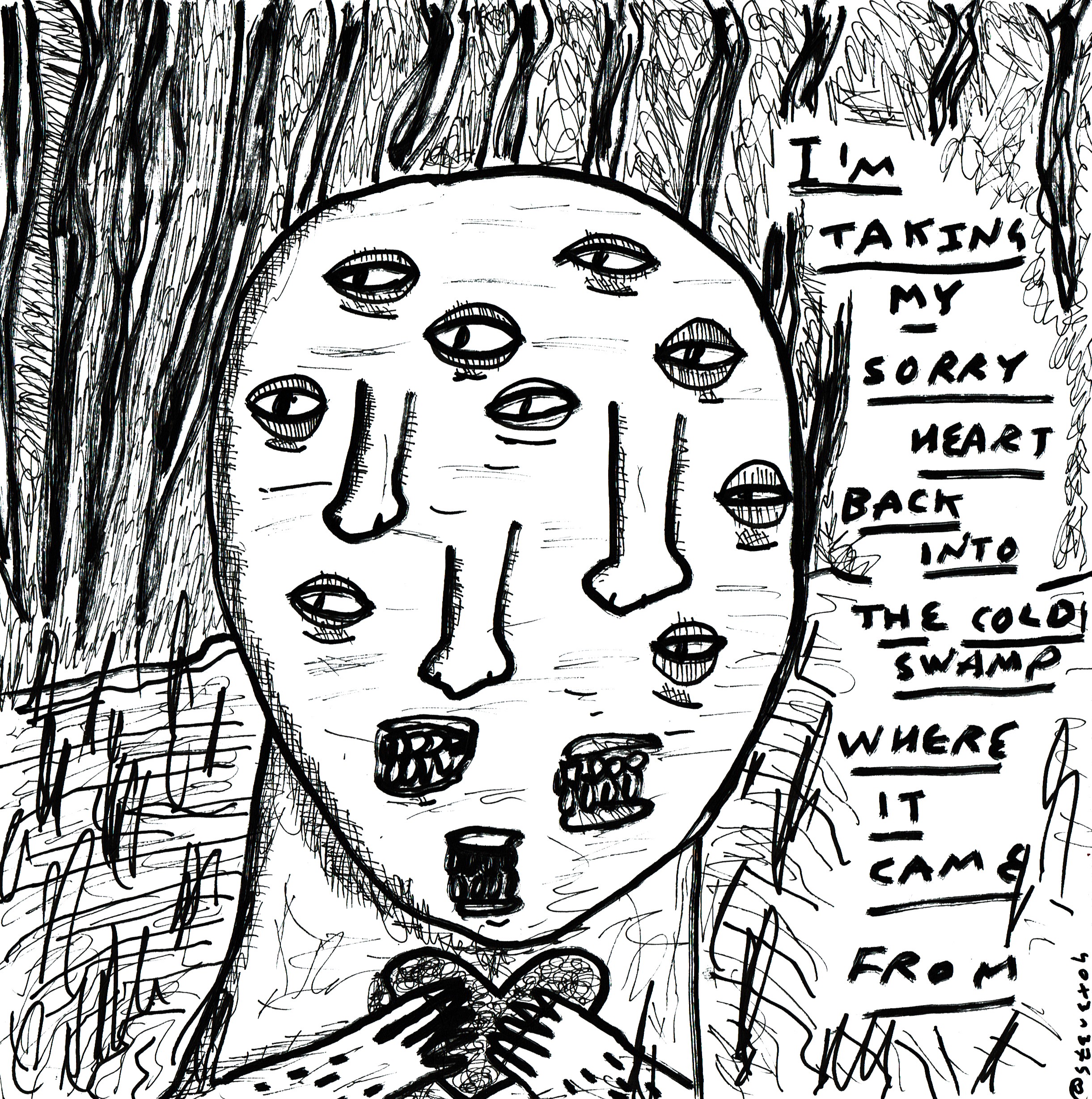
I like to think of these idealised self-images as the posters my inner critic pins up on its bedroom wall. It lies on its bed, staring at these ghostly posters of the past, witnessing them in the present, utterly absorbed and wishing I could measure up to the images portrayed. Theres the poster of idealised super-social-life-and-soul-of-the-party Steve. He’s the centre of attention, smiling and laughing, mingling and networking with everyone no matter what the occasion is or who is talking to him. Then there’s idealised Open Mic Steve who confidently performs songs he has written in such a way that the audience flock to chat with him afterwards, asking where they can buy his music and book tickets to his next well-paid gig. And then there’s idealised Christmas Steve who has lived a life so normal and sensible and professional that Christmas really is the happiest time of the year for him and all who hang out with him during a super-social and emotionally cosy festive period. It seems my inner critic puts this last one up on 1st December, at the same time it puts up its decorations.
Of course, these posters aren’t real, but I have found that imagining them and drawing them in exquisitely exaggerated detail is an immensely helpful practice. Not only does it deepen my awareness of the complexity of my lived experience, the wild exaggerations also help me appreciate the ridiculousness of it all. If nothing else, these posters help me find more self-compassion in times when I most need it.
What really fascinates me though is why some things don’t bother me at all. I really don’t care if anyone likes my art or not. If I do a talk or run a workshop and people don’t respond well to it, I might be disappointed, but I’m not crushed by it. And if I am obsessed with a new fascination or a new project or something that makes me come across as strange or eccentric I really don’t mind if people think I’m weird. I think the reason for all of this is because my Inner Critic doesn’t have idealised Art Steve or idealised Speaker Steve or idealised Neuro-typical Steve posters. Maybe it used to have them, but they seem to have been taken down for some reason, possibly because I laughed at how ridiculous they looked.
I came up with the metaphor of Shit Snap at one of our Inner Critic workshops many years ago and I’ve found it personally helpful in making sense of all this. It’s based on the children’s card game Snap - the one where you take turns laying down cards and, when two of the same appear, the first person to shout “Snap!” wins. In Shit Snap, the horribly diminishing and self-loathing SNAP only happens when a belief we hold about ourselves matches one of the posters the inner critic has pinned up on its wall. This goes some way to explaining why some feedback hurts deeply (SNAP!) and other comments just float by like a slightly strange-smelling cloud.

 Apple
Apple Spotify
 Pocket casts
 Youtube
 Audible
 Substack