Creative Adventures - podcast and Substack newsletter logo
Kingstonymus Bosch - an essay by @stevexoh

Kingstonymus Bosch
by Steve Xoh

I find the festive season hard. Which doesn’t feel like the cheeriest way to begin an issue of this Substack that comes out on Boxing Day! But it is a feeling that tends to hijack me at this time of year - one that I can’t really describe but feels quite unsettling. I used to love Christmas as a kid and even more so when my daughter was born. But there have been some big changes in my life since then that have meant I have come to associate this time of year with difficult feelings. This seems to have resulted in me becoming quite sensitised to Christmas stuff like seeing decorations or hearing Christmas songs or the subtle societal suggestion that it is the happiest time of the year and everyone is looking forward to it.

I do, however, notice that Christmas 2025 feels a little different. It feels like I have maybe managed to process some important things over the last year that leave me feeling apprehensive but more emotionally resilient as Christmas approaches. One of the big things that I have done this winter is to sit and reflect on what my own needs are over the festive period and what I can do to better meet them. As a result of this, I decided to book an Airbnb by the sea for me and Poppy the dog to stay in on Christmas Day. The time Poppy and I had in the beach hut earlier this year was so special and nurturing that I realised this is what I’d really like to do, even though it has seemed like a strange choice to others. There are a number of humans I like the idea of spending Christmas with but, if I am really honest with myself, spending three days by the sea with my lovely dog friend is what I need. But even though I feel more seasonally resilient this year, I still notice an embodied reaction to some things.

My studio is in Kingston-upon-Thames in South West London. Kingston is an ancient market town dating back to AD 838 and is where some of the Saxon kings were crowned. It has a lovely smattering of old buildings and the authorities love transforming the market square into a “traditional” winter wonderland with wooden market huts, lights and a sound system playing seasonal music all day. And whilst this is great for visitors who enjoy the sights, sounds and smells of Christmas, it does something to my nervous system every time I walk through it. So I have started intentionally walking a different route back home via the busier, but less festively embellished riverside.

It was whilst walking this slightly different way in late November that I stumbled across one of the weirdest and most fascinating things I have ever seen in the town - a bizarre mural that I nicknamed Kingstonymus Bosch. I had seen the mural out of the corner of my eye on my regular runs along the river and just assumed that it was a traditional Christmas scene set in ancient Kingston. From a distance it looked like it depicted crowds of people with flashes of red and white festive colours, some wooden structures that looked like market stalls and some water that I assumed was the Thames. But my diversion home allowed me to stop and look at it more closely and I gradually realised that there was so much more to this art installation than I had initially thought.

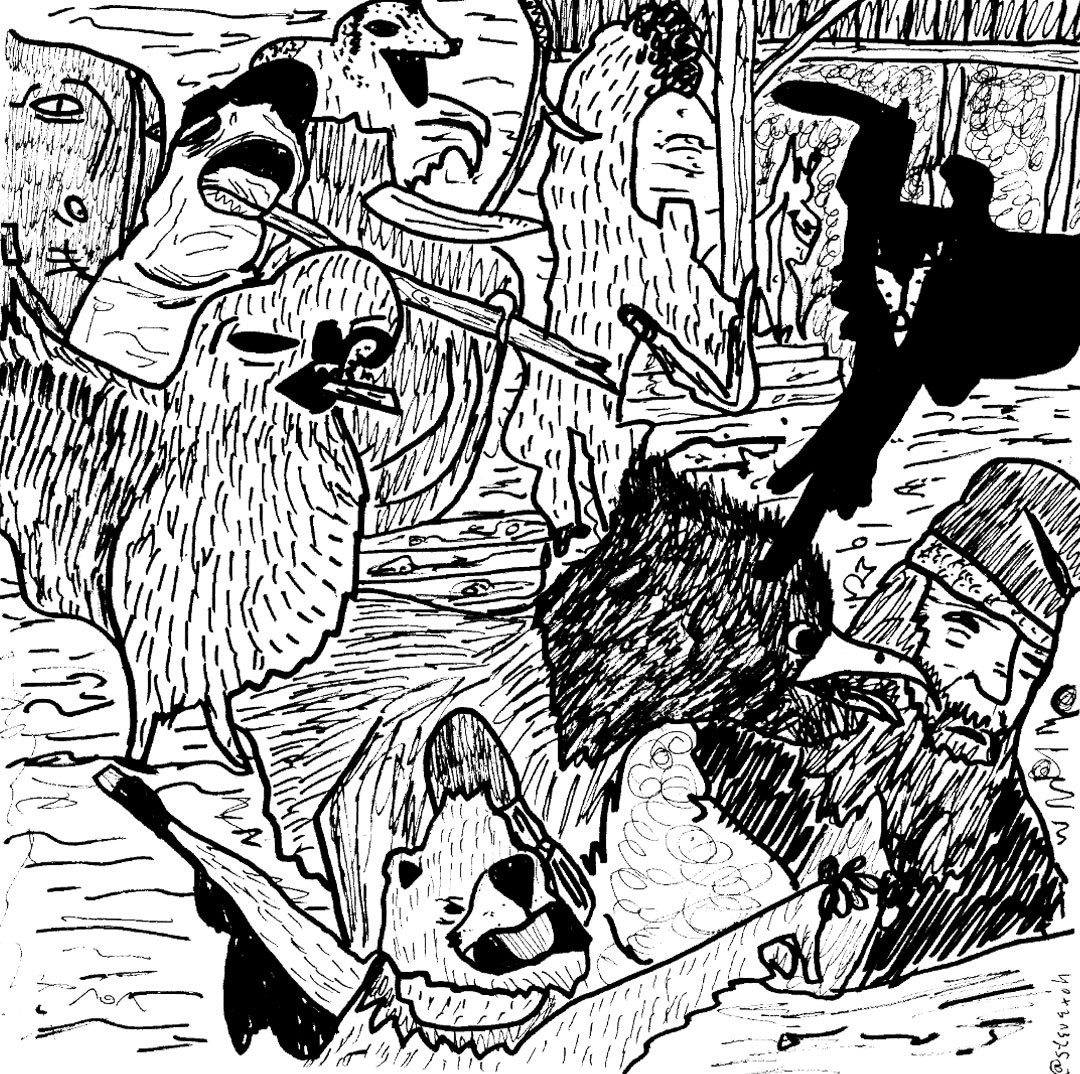
The first thing I noticed was that it didn’t look like Kingston at all. There were none of the iconic ancient buildings and the river was more like a shallow flood that the crowds of people were wading through. I also started to realise that the people in the scene looked nothing like the crowds of people crammed into the Christmas Market that I was carefully avoiding. Many of them looked really odd. Noses out of place, flaps of skin folded over eyes, limbs disappearing or poking out at strange angles. And then I noticed the creatures! What I had initially thought were dogs or swans or horses were actually surreal beasts from another dimension. Bizarre mixes of different species, as if a mad taxidermist and Dr Frankenstein had collaborated and then set their creations loose to terrorise the poor gaggle of malformed humans. The interactions between the humans and creatures made no sense at all, at least not in this reality. Human arms and bird wings merged. A penguin was on fire for no apparent reason. And a strange bird-wolf creature looked like it was about to savagely eat a depressed Santa Clause who had clearly given up on life.

This was obviously the work of AI and it caused a conflict of responses in me. Whilst I can appreciate there are some genuine benefits of AI, I’m not a fan of it for many reasons. There’s the environmental impact due to the energy it consumes, the economic impact in terms of human jobs it puts under threat and, most importantly as an artist, how it borrows/steals art created by human artists and re-purposes it as its own. (I know it’s more complicated than this but I don’t want to use up any more of this Substack talking about the downsides of AI!) But, at the same time, I loved the absolute surrealist mystery of this huge mural. There was no writing on it and I couldn’t work out where it came from, what it was about or who put it there.

Very soon Kingstonymous Bosh started to crop up in overheard conversations between locals and I began to notice more and more posts on social media about it. Some people shared my mix of confusion and wonder. Some people were angry about it, accusing the local council of wasting tax-payers money when there were many other things it could be spent on. (Kingston council made it clear, very quickly, that they had nothing to do with the mural.) Some people demanded it be replaced with a more traditional festive scene depicting the real Kingston. I did a talk at a local art college and the tutors were debating it and trying to make sense of it from an artistic perspective. The company that runs our studios got a number of press inquiries asking if it was one of their artists that had created it. And a number of Reddit threads, news articles and social media posts started to turn Kingstonymus Bosch into a bit of a tourist attraction with people travelling to see “London’s horrific AI mural.

The more I learnt about the intensity of the response to the mural, the more I began to love it. The American artist Ed Roche once said that it is easy to tell the difference between good art and bad art. He said bad art makes you go “wow…..huh?” You think it is initially amazing but after a while you realise it is nothing special and forget about it. But good art makes you go “huh…wow!” It baffles, confuses, disturbs but, over time, gradually reveals its subversive brilliance to you. And that’s exactly what I experienced with Kingstonymus Bosch - a genuine experience of “Huh?………WOW!

Putting aside whether this was the intention of the artist/commissioner, Kingstonymous Bosh was a brilliant pattern interrupter. Something that disturbed the everyday routine of people passing through the town. It provoked a whole mix of emotions from confusion to amusement to anger to disgust. It catalysed conversations about AI, tradition, art and, most relevant for the Kingston artist community, questions about why a local human artist wasn’t commissioned to create it. The depiction of a largely non-white population and the presence of small boats triggered polarising conversations and arguments about immigration and politics. And, even though I have little love for AI art and very much doubt it was intentionally made this bizarre, I loved Kingstonymous Bosh for the plethora or reactions it provoked. The Mexican poet Cesar A. Cruz famously said “Art should comfort the disturbed and disturb the comfortable” and Kingstonymus Bosch ticked all of these boxes.

Eventually, due to “public outcry” and “local backlash” the mural was removed. I was sad and frustrated when I heard this. The energy had already been used to generate the AI art, and the materials had already been consumed to print it on a massive canvas, so the environmental damage was already done. But more so, I was sad that the general consensus around its removal seemed to be that art should be pleasant pictures that make sense and that everybody likes. Art can, of course, be likeable and popular. But for me, its real power lies in the way it can interrupt, captivate, disturb, distort and ultimately reflect back parts of ourselves we may not be ready to witness.

This essay was originally published on Substack. You can listen to the podcast in which Steve talks about this essay via the listening links below.

Kingstonymus Bosch
by Steve Xoh

I find the festive season hard. Which doesn’t feel like the cheeriest way to begin an issue of this Substack that comes out on Boxing Day! But it is a feeling that tends to hijack me at this time of year - one that I can’t really describe but feels quite unsettling. I used to love Christmas as a kid and even more so when my daughter was born. But there have been some big changes in my life since then that have meant I have come to associate this time of year with difficult feelings. This seems to have resulted in me becoming quite sensitised to Christmas stuff like seeing decorations or hearing Christmas songs or the subtle societal suggestion that it is the happiest time of the year and everyone is looking forward to it.

I do, however, notice that Christmas 2025 feels a little different. It feels like I have maybe managed to process some important things over the last year that leave me feeling apprehensive but more emotionally resilient as Christmas approaches. One of the big things that I have done this winter is to sit and reflect on what my own needs are over the festive period and what I can do to better meet them. As a result of this, I decided to book an Airbnb by the sea for me and Poppy the dog to stay in on Christmas Day. The time Poppy and I had in the beach hut earlier this year was so special and nurturing that I realised this is what I’d really like to do, even though it has seemed like a strange choice to others. There are a number of humans I like the idea of spending Christmas with but, if I am really honest with myself, spending three days by the sea with my lovely dog friend is what I need. But even though I feel more seasonally resilient this year, I still notice an embodied reaction to some things.

My studio is in Kingston-upon-Thames in South West London. Kingston is an ancient market town dating back to AD 838 and is where some of the Saxon kings were crowned. It has a lovely smattering of old buildings and the authorities love transforming the market square into a “traditional” winter wonderland with wooden market huts, lights and a sound system playing seasonal music all day. And whilst this is great for visitors who enjoy the sights, sounds and smells of Christmas, it does something to my nervous system every time I walk through it. So I have started intentionally walking a different route back home via the busier, but less festively embellished riverside.

It was whilst walking this slightly different way in late November that I stumbled across one of the weirdest and most fascinating things I have ever seen in the town - a bizarre mural that I nicknamed Kingstonymus Bosch. I had seen the mural out of the corner of my eye on my regular runs along the river and just assumed that it was a traditional Christmas scene set in ancient Kingston. From a distance it looked like it depicted crowds of people with flashes of red and white festive colours, some wooden structures that looked like market stalls and some water that I assumed was the Thames. But my diversion home allowed me to stop and look at it more closely and I gradually realised that there was so much more to this art installation than I had initially thought.

The first thing I noticed was that it didn’t look like Kingston at all. There were none of the iconic ancient buildings and the river was more like a shallow flood that the crowds of people were wading through. I also started to realise that the people in the scene looked nothing like the crowds of people crammed into the Christmas Market that I was carefully avoiding. Many of them looked really odd. Noses out of place, flaps of skin folded over eyes, limbs disappearing or poking out at strange angles. And then I noticed the creatures! What I had initially thought were dogs or swans or horses were actually surreal beasts from another dimension. Bizarre mixes of different species, as if a mad taxidermist and Dr Frankenstein had collaborated and then set their creations loose to terrorise the poor gaggle of malformed humans. The interactions between the humans and creatures made no sense at all, at least not in this reality. Human arms and bird wings merged. A penguin was on fire for no apparent reason. And a strange bird-wolf creature looked like it was about to savagely eat a depressed Santa Clause who had clearly given up on life.

This was obviously the work of AI and it caused a conflict of responses in me. Whilst I can appreciate there are some genuine benefits of AI, I’m not a fan of it for many reasons. There’s the environmental impact due to the energy it consumes, the economic impact in terms of human jobs it puts under threat and, most importantly as an artist, how it borrows/steals art created by human artists and re-purposes it as its own. (I know it’s more complicated than this but I don’t want to use up any more of this Substack talking about the downsides of AI!) But, at the same time, I loved the absolute surrealist mystery of this huge mural. There was no writing on it and I couldn’t work out where it came from, what it was about or who put it there.

Very soon Kingstonymous Bosh started to crop up in overheard conversations between locals and I began to notice more and more posts on social media about it. Some people shared my mix of confusion and wonder. Some people were angry about it, accusing the local council of wasting tax-payers money when there were many other things it could be spent on. (Kingston council made it clear, very quickly, that they had nothing to do with the mural.) Some people demanded it be replaced with a more traditional festive scene depicting the real Kingston. I did a talk at a local art college and the tutors were debating it and trying to make sense of it from an artistic perspective. The company that runs our studios got a number of press inquiries asking if it was one of their artists that had created it. And a number of Reddit threads, news articles and social media posts started to turn Kingstonymus Bosch into a bit of a tourist attraction with people travelling to see “London’s horrific AI mural.

The more I learnt about the intensity of the response to the mural, the more I began to love it. The American artist Ed Roche once said that it is easy to tell the difference between good art and bad art. He said bad art makes you go “wow…..huh?” You think it is initially amazing but after a while you realise it is nothing special and forget about it. But good art makes you go “huh…wow!” It baffles, confuses, disturbs but, over time, gradually reveals its subversive brilliance to you. And that’s exactly what I experienced with Kingstonymus Bosch - a genuine experience of “Huh?………WOW!

Putting aside whether this was the intention of the artist/commissioner, Kingstonymous Bosh was a brilliant pattern interrupter. Something that disturbed the everyday routine of people passing through the town. It provoked a whole mix of emotions from confusion to amusement to anger to disgust. It catalysed conversations about AI, tradition, art and, most relevant for the Kingston artist community, questions about why a local human artist wasn’t commissioned to create it. The depiction of a largely non-white population and the presence of small boats triggered polarising conversations and arguments about immigration and politics. And, even though I have little love for AI art and very much doubt it was intentionally made this bizarre, I loved Kingstonymous Bosh for the plethora or reactions it provoked. The Mexican poet Cesar A. Cruz famously said “Art should comfort the disturbed and disturb the comfortable” and Kingstonymus Bosch ticked all of these boxes.

Eventually, due to “public outcry” and “local backlash” the mural was removed. I was sad and frustrated when I heard this. The energy had already been used to generate the AI art, and the materials had already been consumed to print it on a massive canvas, so the environmental damage was already done. But more so, I was sad that the general consensus around its removal seemed to be that art should be pleasant pictures that make sense and that everybody likes. Art can, of course, be likeable and popular. But for me, its real power lies in the way it can interrupt, captivate, disturb, distort and ultimately reflect back parts of ourselves we may not be ready to witness.

This essay was originally published on Substack. You can listen to the podcast in which Steve talks about this essay via the listening links below.

(C) Stevexoh 2025