I only ever half-read books, even ones that I am really interested in, and “How to Teach Quantum Physics to Your Dog” by Chad Orzel is one of them. I didn’t stop reading it because I didn’t like it - I just find books hard work so it is easy to get distracted and forget I was reading them.
But one paragraph from this book has stuck with me ever since:
”Quantum mechanics seems baffling and troubling to humans because it confounds our common-sense expectations about how the world works. Dogs are a much more receptive audience. The everyday world is a strange and marvellous place to a dog and the predictions of quantum theory are no stranger or more marvellous than, say, the operation of a doorknob.”
For me this passage beautifully articulates the concept of wonder, a word I have grown to adore and a word that seems wistfully absent in our modern day to day lives. We are born into an experience of wonder where nothing makes sense, meaning is fleeting and, if we feel safe and secure enough, everything is an object of fascination and curiosity. And then, as we learn the way the world works and our perceived place in it, that raw and visceral wonder is gradually replaced by knowledge. And the sadness for me in all of this is that human wonder can be such a powerful force for change, connection, dialogue, empathy and creativity in all areas of humanity. But it seems the concept of wonder sits in a stark opposition to the powerful positivist forces of logic, strategy, agency and expertise which have become the largely unquestioned norms of what it means to be a productive, effective and mature adult human being. Wonder gets consigned to the sidelines only to be indulged in when the important, tangible and real work has been sufficiently completed.
I have come to believe that the practice of not knowing sits at the heart of nurturing wonder. It is the most important (and difficult) practice in my own life and lies at the core of work I do with others. Whether I am doing a talk, running a workshop, facilitating a group or working 1:1 with somebody, if we are unable to nurture our ability to not-know together then the creative potential of the work feels significantly dampened. (This is why I aim for my talks and workshops to fascinate, intrigue but not really make sense.)
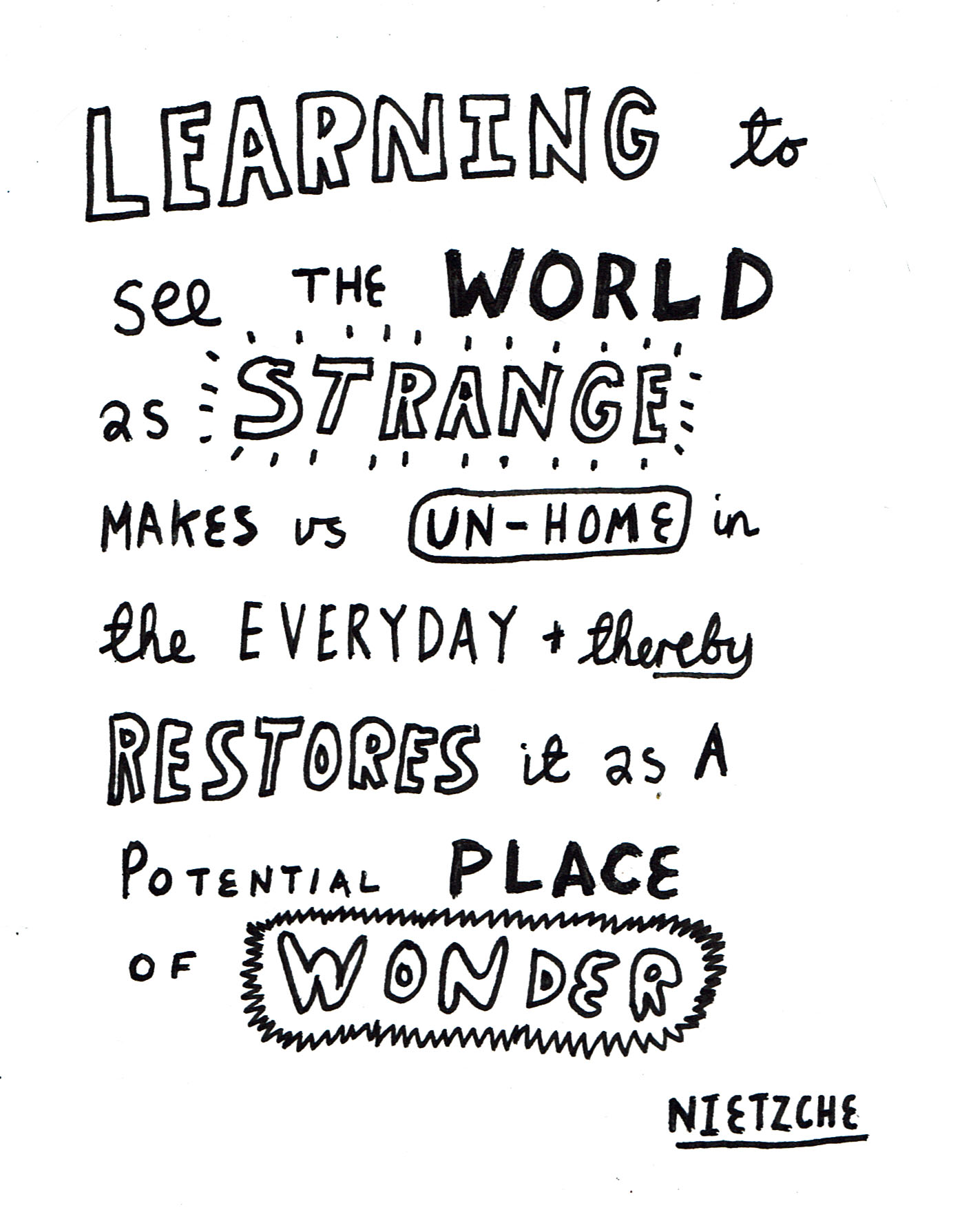
During the 2020 lockdown, in my old Art Bunker studio, I had a quote by Frederich Nietzche on my wall that said “Learning to see the world as strange makes us unhome in the everyday and thereby restores it as a potential place of wonder.” I had this on the wall because I was doing a lot of online workshops and would regularly refer to it but also because it really spoke to me in a number of ways. Each element of it seemed to articulate exactly why the practice of not knowing had become so important to me:
“Learning to see the world as strange…” - the importance of continually challenging the things I have come to regard as normal or real. To question what Alfred North Whitehead referred to as “the fallacy of misplaced concreteness”. To strive to experience at least a tiny fraction of my day-to-day experience in the spirit of the dog in Chad Orzel’s book. To gaze at a tree or a spider or a car from a state that genuinely enables me to think and feel “what the **** is that thing?!
“…makes us unhome in the everyday…” - the importance of confusion, dissonance, disorientation (etc) as a vitally important part of our human experience and a sign we are on the edge of not knowing. To develop a tolerance of these experiences and regard them as being as important as clarity, lucidity and certainty. To develop enough of a sense of safety to allow ourselves to sit in the unhomeness for a little bit longer each time and seek experiences that engender this. To start to realise that these experiences aren’t necessarily a sign that something is going wrong but are in fact a sign that we are on the edge of something new.
“..and thereby restores it as a potential place of wonder.” - this final phrase beautifully ties up the whole quote and encapsulates the importance of not knowing. We are not practicing not knowing as an act of self-flagellation or to develop some sort of stoic resilience - we are doing it because it starts to shift our experience of reality to be one that glistens and sparkles a little bit more. To encounter everyday wonder in a such a way that it energises and motivates us to take action, play, experiment.
In her essay entitled “On the Value of Not Knowing – Wonder, Beginning Again and Letting Be”, Rachel Jones suggests that one of the major challenges facing artists is to resist the desire to reduce the strange to the familiar. She proposes that a vital part of any artist’s practice is “remaining open to the strangeness, being prepared to lose ourselves in the encounter [and] risking not knowing as the condition of possible transformation.” I think this is wonderful invitation, not just for artists, but for any human wishing to live a life more imbued with creativity, adventure and wonder.

 Apple
Apple Spotify
 Pocket casts
 Youtube
 Audible
 Substack