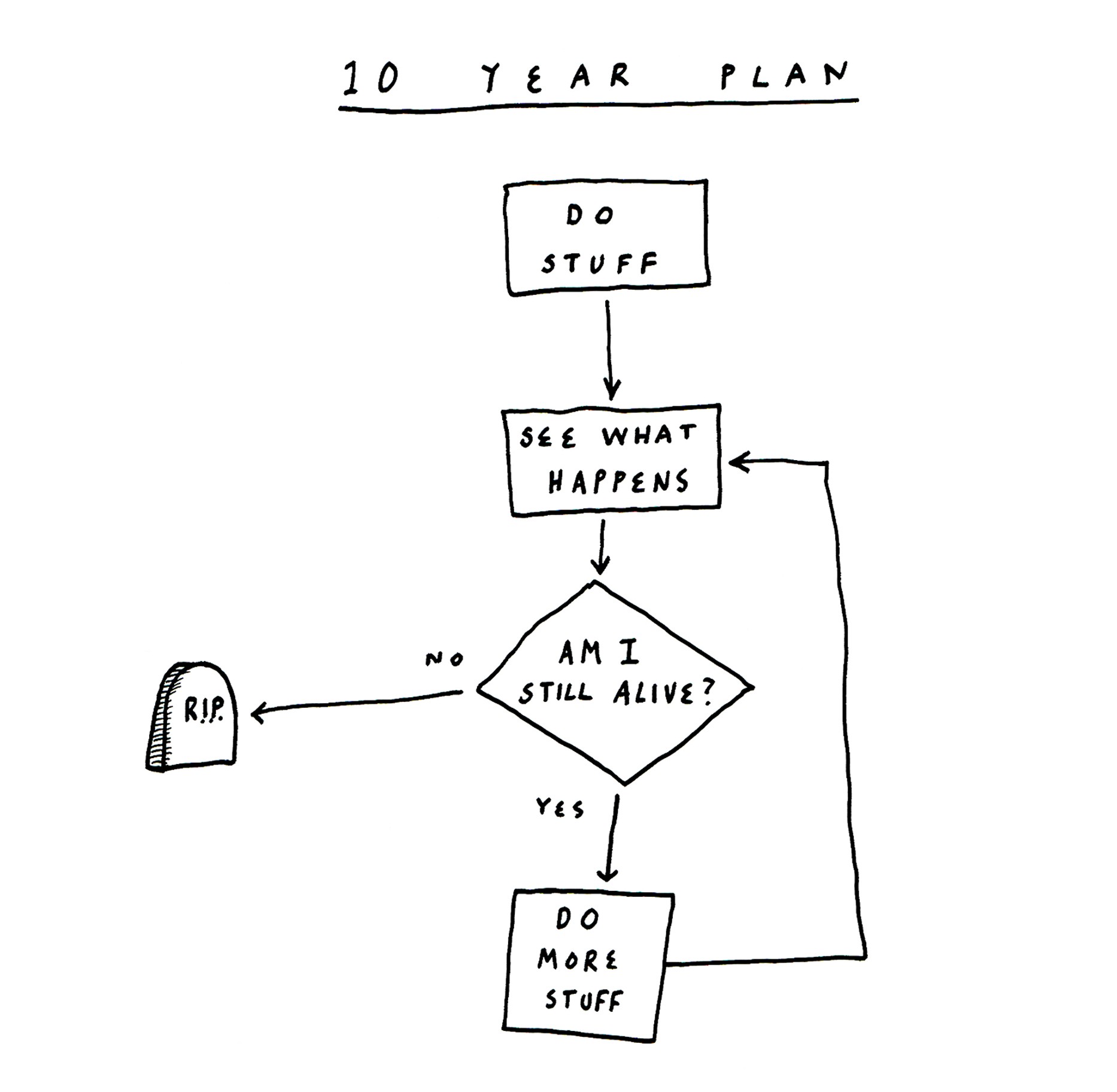
I drew this at 9am on January 1st 2020 in response to feeling rather overwhelmed at the thought of a new decade and wondering how on earth I could summon the energy to get through it. It went on to become one of my best-selling prints, especially once lockdown hit a few months later and the flow chart became an important psychological anchor for people over the two years that followed.
It was a very strange and discombobulating time but I was pleased that my anxious doodle ended up bringing hope and amusement to many people. One thing I notice, reflecting back on lockdown, is that my relationship with Instagram was different back then. From 2020 to 2023 I adored it. I loved that this simple app meant I could make some art, upload it, and people across the world could see it. I started my What the February?! annual challenge on Instagram around the same time, which made the platform feel even more like a place where I could connect with a wonderful and supportive community around the world.
But as many independent creators will tell you, the platform has changed significantly since then. Even though I have more followers now than I did back in 2020, fewer people see my work. The platform now prioritises video over still images and human faces over abstract artwork. Maybe to my detriment, I refuse to play the game of changing what I do simply to satisfy an algorithm whose motivation is to keep people distracted long enough to make money from advertising. Over the six years since I posted that doodle, I have totally fallen out of love with Instagram.
I have always strived to only post new things that I have made, but in January 2026 I thought to myself “I am done with Instagram” and, as an act of resignation, I re-posted the 10 Year Plan. I had anticipated that even fewer people would engage with something old, so I was utterly surprised when it very rapidly went viral. Within a week the post had amassed over one million views and thousands of shares. It was as if Instagram knew what I was thinking and decided, as a one-off, to bring my work to a huge new audience, which I begrudgingly appreciated, especially as it led to increased sales of the print in my shop.
But one re-share of my artwork caught my eye. It was my 10 Year Plan but it had been altered using an imperfect copy of my handwriting to make it all about fitness and working out. What was more alarming was that my signature had been removed from the piece and replaced with the tag of a fitness influencer with 100,000 followers. My brow furrowed when I saw this. I have had my signature removed from things in the past, which isn’t great, but is all part of the rich mix of sharing stuff online. But the fact that the image had been altered and somebody else’s details added didn’t sit right with me.
What confused me though, was that the creator had tagged me with a comment that said “Inspo by @stevexoh”, which felt like they were trying to acknowledge their source, so I decided to let it go. But that night it kept playing on my mind. This was my work, and somebody had plagiarised it in order to appeal to their already substantial audience and grow their following.
I decided to practise being assertive and added a comment to the post, saying “Hmm. It would have been nice to be asked for permission before you posted this unauthorised collab!” A number of my followers also added comments, calling out the lack of ethics and artistic integrity in repurposing my work in this way. (I very quickly requested that this was done in a way that was assertive but also kind - comment on the act, not the person.) After a day or so, the post was suddenly removed and I received a very apologetic DM from the creator, who said they had clearly misjudged the post, made a mistake and thanked me for being kind in pointing this out. I replied that it really wasn’t a problem and explained my perspective as a professional artist. It felt like the situation was resolved in a mutually adult way.
But the thing that really struck me about the exchange of messages was when the creator said, “I loved your meme and meant to showcase it with credit, not cause any disrespect.” My immediate thought was that this clearly isn’t a meme - it is art. But then I stopped and realised what had happened. Two people, one from the world of meme culture and the other from the world of art, had suddenly collided.
I realised that this is exactly how meme culture works. Nobody pauses to research the origins of a meme - it is opened, laughed at, and forwarded. Memes have become culturally regarded as open-source images that can be modified and passed on, becoming their own variations. It is rare that the originator of the image is known, so even rarer that somebody would think of crediting them. And that’s what the 10 Year “fitness” plan poster had gone out of their way to do, which explains why they were so shaken by my reaction and that of my followers. They had tried to do the right thing by crediting me in a comment as they shared their own remix of my work. In the art world this is regarded as unethical and unacceptable, but within meme culture this is actually more considerate than the norm.
I have found this whole experience fascinating. The viral nature of my 10 Year Plan protest re-post plunged my work into a world where the norms and practices were different from what I was used to. It has made me wonder about the real difference between art and memes. If I put aside my own biases, I’m left wondering what actually separates them. After all, all art is theft at some level. Everything is a remix of everything else. And whilst I don’t agree with what happened, I am genuinely curious about the norms in these two worlds and how they might co-exist. As meme culture continues to grow and expand, what does this mean for artists who simply want to share their work and be credited for the time, effort and experience they poured into it?

 Apple
Apple Spotify
 Pocket casts
 Youtube
 Audible
 Substack