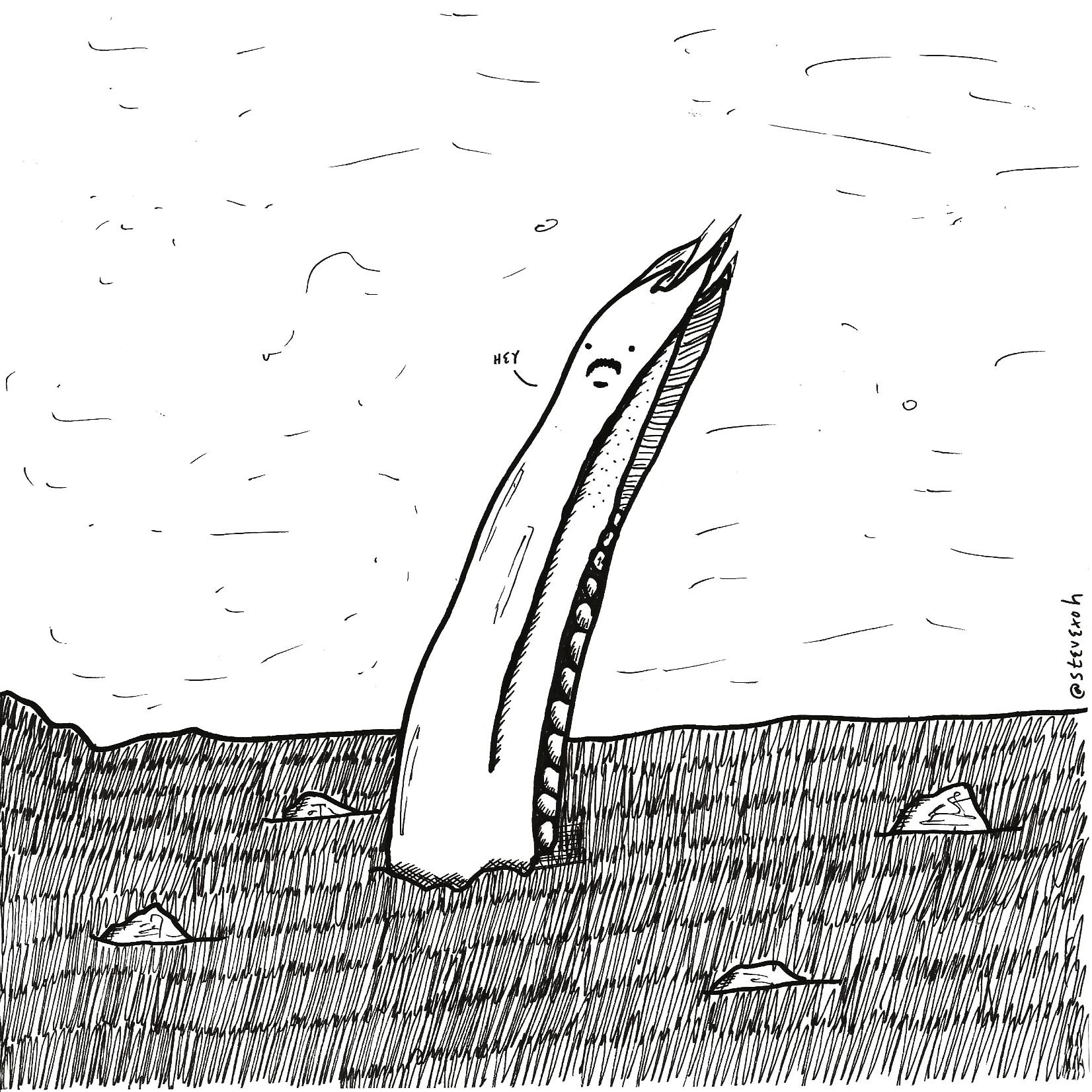
Amphioxus are tiny, translucent sea creatures that burrow into the sandy seabed. Only the front end of their body sticks out as they filter-feed, capturing plankton from the water that passes through their gill slits. Fossil evidence shows that amphioxus-like creatures have existed in this way for over 500 million years and, in that time, their form has changed very little - a very simple design that has turned out to be incredibly effective in evolutionary terms.
I first learnt about amphioxus from the book 7 ½ Lessons About the Brain by Lisa Feldman Barrett, an esteemed neuroscientist and psychologist whose work challenges many traditional assumptions about how the brain works. Feldman Barrett begins the book by introducing amphioxus as a distant relative of ours, sharing a common ancestor that lived during the Cambrian period. While amphioxus retained this original body plan, other animals that eventually gave rise to vertebrates evolved more complex features and systems to support more complex needs such as movement, evading predators and hunting. Amphioxus, however, remained essentially a translucent “stomach on a stick”, while these new creatures required additional systems: a cardiovascular system to pump blood, a respiratory system to take in oxygen and expel carbon dioxide, as well as hormone systems, waste management systems and muscle systems to balance and coordinate a much more complex body.
Feldman Barrett uses this evolutionary process to challenge dominant beliefs about our brain’s primary function. She suggests that “the brain’s job is not thinking… it is running a little worm body that has become very, very complicated.” In this view, the main function of the brain is allostasis – the process of continual change by which an organism adjusts its internal functions to maintain physiological stability. Feldman Barrett therefore suggests that the brain’s main role is simply to manage resources. She compares it to a complex financial investment firm, comprising a number of dedicated divisions and departments that “invest energy in the hope of earning a good return: food, affection, protection.”
I get excited by anything that challenges dominant narratives, but especially when it is about how we perceive ourselves as a species. While I am interested in neuroscience, I have always thought it is fundamentally flawed in that it is a field in which human brains are studying human brains, using equipment created by human brains, and a scientific method that has collectively been agreed as robust by human brains. It all feels a little biased to me. If it were a different species doing all of this, perhaps a totally different life-form from another planet, then I’d be much more inclined to believe the findings were real and accurate.
What really fascinates me about Lisa Feldman Barrett’s work is that it invites us to rethink the brain’s role in terms of creativity. Her research shows the triune brain model to be flawed and the left-brain/right-brain theory to be terribly oversimplified. As a result, the brain begins to look less like a thinking machine and more like a set of highly professional accounting departments managing resources to meet the body’s needs. (I can’t help but wonder whether the brain is light grey because that’s the dress code for the accountants in there.)
So maybe the brain actually has far less to do with creativity than we have been led to believe. Its role may simply be to ensure we have the energy and sense of safety required to express it - a support function enabling something much more mysterious and exciting to arise from elsewhere within us. This perspective completely flips the dominant narrative that the brain and its tendency towards logical, linear and rational thought are the source of everything humanly brilliant.
The wonderfully weird comedian Emo Philips sums up this exciting shift in perspective:
“I used to think that the brain was the most wonderful organ in my body. Then I realised who was telling me this.”

 Apple
Apple Spotify
 Pocket casts
 Youtube
 Audible
 Substack