Creative Adventures - podcast and Substack newsletter logo
Quantum flirts and back gaemen - an essay by @stevexoh

Quantum flirts and back gaemen
by Steve Xoh

A question I am often asked is “So what’s next?” And for 80% of the time my honest answer is “I don’t know.”

The question normally comes after a talk or an exhibition or an interview. I guess it primarily comes from a place of curiosity and wondering what weird and wonderful future stuff might be lurking in my brain. (I’ve likely asked other people this question from a similar place). But I can’t help but become curious about the assumptions that sit behind the question. Assumptions about me and how my mind works as well as general assumptions about creativity, productivity and what it means to “successfully” live a creative life. Is there an assumption that there is just this constant flow of projects and ideas in my mind lining up like planes coming into an airport? How much is it informed by societal assumptions about productivity and the idea that being busy = being successful. And what do people think when I tell them that there isn’t anything and that I don’t know what’s next. Are they disappointed? Do they perceive me as a bit of a failure? And how does all of this make me feel when I seem to be perpetually admitting that I have no plans or ideas right now? (To be clear, I don’t mind being asked the question because not knowing has, in itself, become a very important part of my creative practice.)

I have learnt over the years that putting in effort to come up with ideas is a surefire way to ensure that I don’t ever come up with ideas. I liken it to those floaty things that people sometimes get on their eyes (vitreous floaters). If you try to look at them they disappear from sight, so the only way to see them is to not try looking at them and simply wait for them to appear. I often use the metaphor of vitreous floaters to talk about Arnie Mindell’s concept of Quantum Flirting which has become an important part of my creative practice for many years now.

My understanding of Mindell’s concept is that the way we think about attention is somewhat skewed, or at least unhelpful in a number of ways. The general assumption is that we choose where to place our attention. For example, I just looked up from my desk where I am writing this and noticed a jar of chilli flakes on the kitchen counter. Logic tells me that in that moment I chose to place my attention on the chilli flakes. However, the lens of quantum flirting would suggest that in that moment I was open to hearing the jar of chilli flakes whispering for my attention.

I learnt about quantum flirting from my dear friend and colleague, gestalt psychotherapist Simon Cavvichia back in 2012. The concept spoke to me in such a way that it fundamentally changed how I approach my work,causing a significant shift in my creative philosophy : less effort and focus trying to seek out and hunt down inspiration and instead curating space and quiet and a kind of experimental un-focussing and emptiness in the every day in order to better hear inspiration calling to me. (Moving towards what in gestalt is called the “fertile void”.)

This all sounds great in theory but I find it hard when I am feeling down, uninspired, bored and simply want something to stimulate and engage me. The last thing I want to do is nothing. And there is no guarantee that I will get to a flirtable state where I am open enough to hear the alluring call of a curious question that might just turn into something special. Often there is nothing for a considerable amount of time and I become even more frustrated and despondent. But when a quantum flirt does occur, it feels magical. A moment where something gradually comes into my awareness. Something that was there all along but I just couldn’t quite de-focus and let go enough to see it until now. Previous big projects such as the Sound of Silence podcast, the (Not a) Lost Cat project, Inexpert 2018 and What the February?! all started life as a quantum flirt where I was open enough to hear something in my peripheral awareness calling for my attention.

Back in July this year I was feeling low and bored and wanting a particular type of human connection that always feels paradoxical to me - to be around lots of people in a way that I don’t feel alone but also don’t feel too overwhelmed by too much social interaction. I spent some time searching for things to do in London - looking for galleries, private views, art-like events, talks, gigs but nothing came up that grabbed my interest. (It was also a Tuesday evening and I learnt that’s not the best time for finding events that would meet my very specific social criteria.) But on every search I did, I noticed a board game meetup group in East London kept appearing. I kept ignoring it as, whilst I like board games, the thought of showing up in a pub I’ve never been to, not knowing anyone and trying to find somebody to play a game with felt like a surefire way of experiencing rejection and not fitting in. But this event kept calling to me via the medium of search engine results. So, despite every fibre of my nervous system telling me this was a very bad idea, I grabbed my stuff and left the flat before I could talk myself out of it.

On arriving at the pub I instantly regretted it. Despite arriving right at the start of the event, all the tables were full of people already playing games. Do these people know each other? Are they just all really good at meeting new people and deciding to play? How on earth do I integrate myself into this without coming across like an alien that doesn’t know how to interact with other humans? I spotted a group of 4 people walking up to the pile of games and saw my chance to practice being an adult human being. “Can I join you?” I asked, cringing inside. They looked at each other and then back at me and said “Ahh sorry, we’ve already got a full table and enough for this game.” I replied with a jolly “No problem!” which hid the crushing rejection and desire to flee the scene immediately and never try anything like this again.

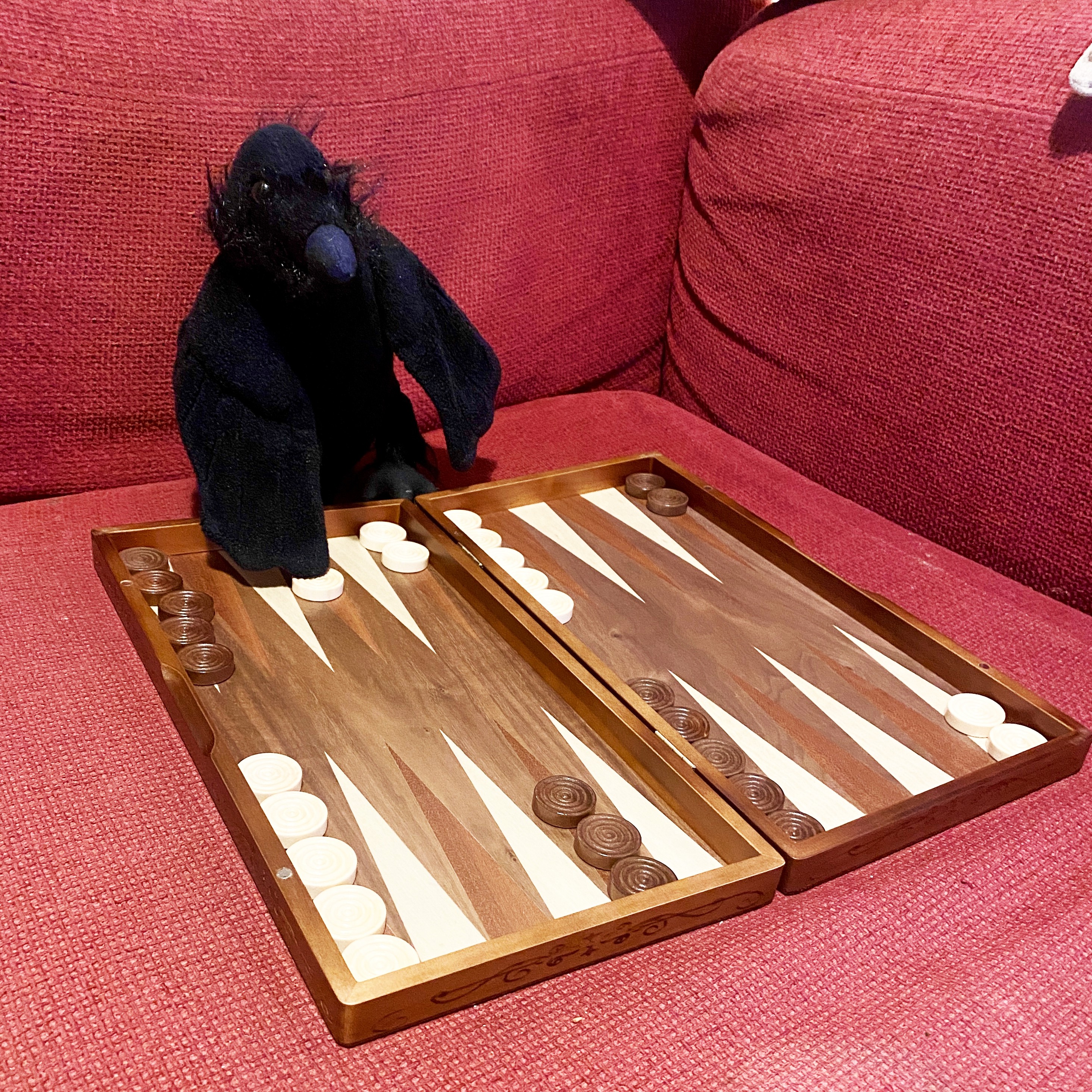
But just as I was about to leave I saw an older guy on his own holding an ornate looking wooden box. He was looking around, presumably for somebody to play with. “Are you looking for somebody to play with?” I asked. “Yes!” he said and we sat down at the only empty table (the tiniest one in the pub) and he opened his box to reveal the game Backgammon. I told him that I had never played Backgammon before and he looked immensely disappointed. I asked him if he could teach me how to play and he didn’t really answer and started looking around the pub for somebody who seemed like a more experienced player. But as there was nobody else around he reluctantly agreed to show me how to play. We played five games. He won four of them, I won one although I suspect he let me win as he felt sorry for me. As we played we spoke. He told me he was from Persia, the region where the game was invented around 5,000 years ago. He told me all about the history of the game and that in the culture he grew up in Backgammon was a fixture of everyday life and he had been playing since he was 5. (Which went someway to explaining why he was able to play so quickly.) He showed me photos of the city in Iran where he had lived and about his experience of coming to live in the UK. I told him all about my life and my art and growing up and living in London. Then as the fifth game came to a close it felt like we reached a natural end to our interaction - we shook hands and I left. No exchange of contact details. No plans to keep in touch. Just a thank you and farewell. I left feeling incredibly socially satiated - a feeling I very rarely get.

Over the next couple of days I became fascinated why this felt like such a nourishing interaction. I mean it wasn’t like Backgammon was the best game I’d ever played. It actually confused me quite a bit and on the way home I was already forgetting the rules. And even though my playing partner was an interesting human being and I enjoyed our conversation, it wasn’t like I was fascinated by him any more than I would be with anyone else.

I then started to realise that, rather than the game or the individual, it was the nature of the interaction that really worked for me. Once I had found somebody to play with and had learnt even the most basic of rules I felt comfortable. I wrote about niche environments in Issue #2 of this Substack - specific habitats in which neurodiverse people can better thrive. (I also suggested that thinking about niche environments is an important thing for all of us to consider whether we regard ourselves as neurodiverse or not.)

For me it felt like the game of backgammon with this stranger provided me with three very important things: 1. A clear focus and reason for the interaction 2. A defined start point, end point and “escape routes” (like at the end of each game) and 3. A mutual, repeated physical activity from which conversation can naturally flow. I realised that when these factors are not present or are unclear to me that I start to find things more socially difficult and have to work harder to stay present and not have a weird out of body experience where I am watching myself trying to be “normal”. (Or drink alcohol to try and numb out of the intensity of it all and feel less inhibited).

I started to wonder if these three factors could become a helpful formula for me to meet new people in a way that helps me feel more like a functional adult. Could they provide enough of a lose structure to avoid feeling awkward, disoriented and trapped - something I often experience in conversation with strangers or people I don’t know very well.

I am always interested in meeting new people but find it hard to figure out ways to do this that work for me - walking into a bar or a party or an event and just striking up conversation or merging to become part of a group isn’t one of my skillsets. It was then that a curious question that would become the catalyst for a weird new project appeared: “I wonder what would happen if I invited strangers to play Backgammon with me?”

I posted an invitation across social media that simply said “Do you want to play Backgammon with me?” and on the 12th August the project began. I met somebody I had never met before in St James’ Park and we played three games of Backgammon surrounded by curious geese who seemed to want to join in. At the end I drew a portrait of the person (who I now officially refer to as “Player #1”), we co-created a haiku about our experience and said goodbye.

As I was walking back to Waterloo I felt elated. Not just because I had experienced a pleasant, engaging and delightfully weird social interaction, but because I got that excited feeling in my gut that this was going to turn into something that I might tell a story about someday. A new experimental project that emerged not through seeking it out but through de-focussing and allowing the board games event and the Iranian man with nobody to play Backgammon with to whisper for my attention. A weird, experimental adventure that arose from a quantum flirt and I’ve absolutely no idea where it will take me.

If you’d like to be part of the Back Gaemen Project you can read more about it here or drop me an e-mail/send me an Instagram DM.

(If you are wondering why I’m calling it the “Back Gaemen Project” - in summary, I dislike the word “Gammon” for various reasons and Back Gaemen is the middle English name for the game that loosley means “coming back to play” which felt much nicer.)

This essay was originally published on Substack. You can listen to the podcast in which Steve talks about this essay via the listening links below.

Quantum flirts and back gaemen
by Steve Xoh

A question I am often asked is “So what’s next?” And for 80% of the time my honest answer is “I don’t know.”

The question normally comes after a talk or an exhibition or an interview. I guess it primarily comes from a place of curiosity and wondering what weird and wonderful future stuff might be lurking in my brain. (I’ve likely asked other people this question from a similar place). But I can’t help but become curious about the assumptions that sit behind the question. Assumptions about me and how my mind works as well as general assumptions about creativity, productivity and what it means to “successfully” live a creative life. Is there an assumption that there is just this constant flow of projects and ideas in my mind lining up like planes coming into an airport? How much is it informed by societal assumptions about productivity and the idea that being busy = being successful. And what do people think when I tell them that there isn’t anything and that I don’t know what’s next. Are they disappointed? Do they perceive me as a bit of a failure? And how does all of this make me feel when I seem to be perpetually admitting that I have no plans or ideas right now? (To be clear, I don’t mind being asked the question because not knowing has, in itself, become a very important part of my creative practice.)

I have learnt over the years that putting in effort to come up with ideas is a surefire way to ensure that I don’t ever come up with ideas. I liken it to those floaty things that people sometimes get on their eyes (vitreous floaters). If you try to look at them they disappear from sight, so the only way to see them is to not try looking at them and simply wait for them to appear. I often use the metaphor of vitreous floaters to talk about Arnie Mindell’s concept of Quantum Flirting which has become an important part of my creative practice for many years now.

My understanding of Mindell’s concept is that the way we think about attention is somewhat skewed, or at least unhelpful in a number of ways. The general assumption is that we choose where to place our attention. For example, I just looked up from my desk where I am writing this and noticed a jar of chilli flakes on the kitchen counter. Logic tells me that in that moment I chose to place my attention on the chilli flakes. However, the lens of quantum flirting would suggest that in that moment I was open to hearing the jar of chilli flakes whispering for my attention.

I learnt about quantum flirting from my dear friend and colleague, gestalt psychotherapist Simon Cavvichia back in 2012. The concept spoke to me in such a way that it fundamentally changed how I approach my work,causing a significant shift in my creative philosophy : less effort and focus trying to seek out and hunt down inspiration and instead curating space and quiet and a kind of experimental un-focussing and emptiness in the every day in order to better hear inspiration calling to me. (Moving towards what in gestalt is called the “fertile void”.)

This all sounds great in theory but I find it hard when I am feeling down, uninspired, bored and simply want something to stimulate and engage me. The last thing I want to do is nothing. And there is no guarantee that I will get to a flirtable state where I am open enough to hear the alluring call of a curious question that might just turn into something special. Often there is nothing for a considerable amount of time and I become even more frustrated and despondent. But when a quantum flirt does occur, it feels magical. A moment where something gradually comes into my awareness. Something that was there all along but I just couldn’t quite de-focus and let go enough to see it until now. Previous big projects such as the Sound of Silence podcast, the (Not a) Lost Cat project, Inexpert 2018 and What the February?! all started life as a quantum flirt where I was open enough to hear something in my peripheral awareness calling for my attention.

Back in July this year I was feeling low and bored and wanting a particular type of human connection that always feels paradoxical to me - to be around lots of people in a way that I don’t feel alone but also don’t feel too overwhelmed by too much social interaction. I spent some time searching for things to do in London - looking for galleries, private views, art-like events, talks, gigs but nothing came up that grabbed my interest. (It was also a Tuesday evening and I learnt that’s not the best time for finding events that would meet my very specific social criteria.) But on every search I did, I noticed a board game meetup group in East London kept appearing. I kept ignoring it as, whilst I like board games, the thought of showing up in a pub I’ve never been to, not knowing anyone and trying to find somebody to play a game with felt like a surefire way of experiencing rejection and not fitting in. But this event kept calling to me via the medium of search engine results. So, despite every fibre of my nervous system telling me this was a very bad idea, I grabbed my stuff and left the flat before I could talk myself out of it.

On arriving at the pub I instantly regretted it. Despite arriving right at the start of the event, all the tables were full of people already playing games. Do these people know each other? Are they just all really good at meeting new people and deciding to play? How on earth do I integrate myself into this without coming across like an alien that doesn’t know how to interact with other humans? I spotted a group of 4 people walking up to the pile of games and saw my chance to practice being an adult human being. “Can I join you?” I asked, cringing inside. They looked at each other and then back at me and said “Ahh sorry, we’ve already got a full table and enough for this game.” I replied with a jolly “No problem!” which hid the crushing rejection and desire to flee the scene immediately and never try anything like this again.

But just as I was about to leave I saw an older guy on his own holding an ornate looking wooden box. He was looking around, presumably for somebody to play with. “Are you looking for somebody to play with?” I asked. “Yes!” he said and we sat down at the only empty table (the tiniest one in the pub) and he opened his box to reveal the game Backgammon. I told him that I had never played Backgammon before and he looked immensely disappointed. I asked him if he could teach me how to play and he didn’t really answer and started looking around the pub for somebody who seemed like a more experienced player. But as there was nobody else around he reluctantly agreed to show me how to play. We played five games. He won four of them, I won one although I suspect he let me win as he felt sorry for me. As we played we spoke. He told me he was from Persia, the region where the game was invented around 5,000 years ago. He told me all about the history of the game and that in the culture he grew up in Backgammon was a fixture of everyday life and he had been playing since he was 5. (Which went someway to explaining why he was able to play so quickly.) He showed me photos of the city in Iran where he had lived and about his experience of coming to live in the UK. I told him all about my life and my art and growing up and living in London. Then as the fifth game came to a close it felt like we reached a natural end to our interaction - we shook hands and I left. No exchange of contact details. No plans to keep in touch. Just a thank you and farewell. I left feeling incredibly socially satiated - a feeling I very rarely get.

Over the next couple of days I became fascinated why this felt like such a nourishing interaction. I mean it wasn’t like Backgammon was the best game I’d ever played. It actually confused me quite a bit and on the way home I was already forgetting the rules. And even though my playing partner was an interesting human being and I enjoyed our conversation, it wasn’t like I was fascinated by him any more than I would be with anyone else.

I then started to realise that, rather than the game or the individual, it was the nature of the interaction that really worked for me. Once I had found somebody to play with and had learnt even the most basic of rules I felt comfortable. I wrote about niche environments in Issue #2 of this Substack - specific habitats in which neurodiverse people can better thrive. (I also suggested that thinking about niche environments is an important thing for all of us to consider whether we regard ourselves as neurodiverse or not.)

For me it felt like the game of backgammon with this stranger provided me with three very important things: 1. A clear focus and reason for the interaction 2. A defined start point, end point and “escape routes” (like at the end of each game) and 3. A mutual, repeated physical activity from which conversation can naturally flow. I realised that when these factors are not present or are unclear to me that I start to find things more socially difficult and have to work harder to stay present and not have a weird out of body experience where I am watching myself trying to be “normal”. (Or drink alcohol to try and numb out of the intensity of it all and feel less inhibited).

I started to wonder if these three factors could become a helpful formula for me to meet new people in a way that helps me feel more like a functional adult. Could they provide enough of a lose structure to avoid feeling awkward, disoriented and trapped - something I often experience in conversation with strangers or people I don’t know very well.

I am always interested in meeting new people but find it hard to figure out ways to do this that work for me - walking into a bar or a party or an event and just striking up conversation or merging to become part of a group isn’t one of my skillsets. It was then that a curious question that would become the catalyst for a weird new project appeared: “I wonder what would happen if I invited strangers to play Backgammon with me?”

I posted an invitation across social media that simply said “Do you want to play Backgammon with me?” and on the 12th August the project began. I met somebody I had never met before in St James’ Park and we played three games of Backgammon surrounded by curious geese who seemed to want to join in. At the end I drew a portrait of the person (who I now officially refer to as “Player #1”), we co-created a haiku about our experience and said goodbye.

As I was walking back to Waterloo I felt elated. Not just because I had experienced a pleasant, engaging and delightfully weird social interaction, but because I got that excited feeling in my gut that this was going to turn into something that I might tell a story about someday. A new experimental project that emerged not through seeking it out but through de-focussing and allowing the board games event and the Iranian man with nobody to play Backgammon with to whisper for my attention. A weird, experimental adventure that arose from a quantum flirt and I’ve absolutely no idea where it will take me.

If you’d like to be part of the Back Gaemen Project you can read more about it here or drop me an e-mail/send me an Instagram DM.

(If you are wondering why I’m calling it the “Back Gaemen Project” - in summary, I dislike the word “Gammon” for various reasons and Back Gaemen is the middle English name for the game that loosley means “coming back to play” which felt much nicer.)

This essay was originally published on Substack. You can listen to the podcast in which Steve talks about this essay via the listening links below.

(C) Stevexoh 2025