February saw the three year anniversary of moving into my flat. I normally pay little attention to anniversaries such as this, but this one always feels significant. I had spent much of the previous year house-sitting which, whilst an exciting adventure, was also a time of deep uncertainty and anxiety. So finally finding a stable base felt like a much needed change. But the anniversary of moving into my flat also feels significant because it is inextricably connected to a bizarre, dream-like experience of living on a remote island for a month in the depths of winter.
The island adventure began when my American friend Jim sent me an email saying, “How is your housing situation? I have an idea for you if you are looking for something in January. It would be a very unique experience.” I originally met Jim ten years earlier at a strange creative experiment in the mountains of Spain and we reunited at the same event in the summer of 2022. We bonded further that week through a number of unusual experiences, including getting lost in the Spanish summer heat and accidentally coming face to face with a wild boar. We kept in touch regularly after this, so when I told Jim that I was running out of properties to stay in he was keen to help.
Initially when I read Jim’s email I thought that maybe he had a quirky flat in London that I could stay in, or a remote cabin in the forests of Scotland. But when he told me the property was on Ocracoke Island I jumped onto Google Maps to find out where on earth this place was. As the map loaded I saw this strange-looking, long sliver of land around 30 miles off the coast of North Carolina and thought to myself, “There is no way I can go and live there for a month!” But part of me was intrigued, so I did some research and discovered that the island has a 26km long sandy beach, is virtually deserted in the month of January and is home to a plethora of wildlife, including Atlantic ghost crabs. (This last fact alone sealed the deal for me.)
So I accepted Jim’s kind invitation and told him that I liked the thought of officially making it an art residency. Jim built on this and suggested that the art could be inspired by the places, people and creatures of the island – including the famous “ocracats”. I loved this and proposed that fellow artist jdwoof could come along, as she is known for painting amazing portraits of creatures, including cats. Jim agreed and, as the date for heading off to the island approached, Jo and I invited patrons to help us raise money for art materials. Many people generously obliged.
On the 8th January 2023 I boarded a flight at London’s Heathrow Airport bound for New York, before taking a connecting flight to Wilmington, where I met Jim and his wife Laura. From there we drove three hours through rural North Carolina to the remote ferry terminal at Cedar Island and boarded a ferry across the Pamlico Sound. Three hours later, I finally arrived on Ocracoke Island and the the adventure became very, very real.
Jo wasn’t arriving for another ten days, so when Jim and Laura left I found myself totally alone and very quickly started to think that this whole thing was a terrible mistake. There are no holidaymakers and very few residents on the island in the depths of January and the house I was staying in was some way from the main town. My aloneness very quickly turned into loneliness: a despairing feeling in which I felt no desire or motivation to make any art. What made this feeling worse was that I had £750 worth of art materials on the table that our generous patrons had paid for. It started to feel like the pile of supplies was tormenting me, saying “Come on! You’re supposed to be an artist. Be productive and make some art.”
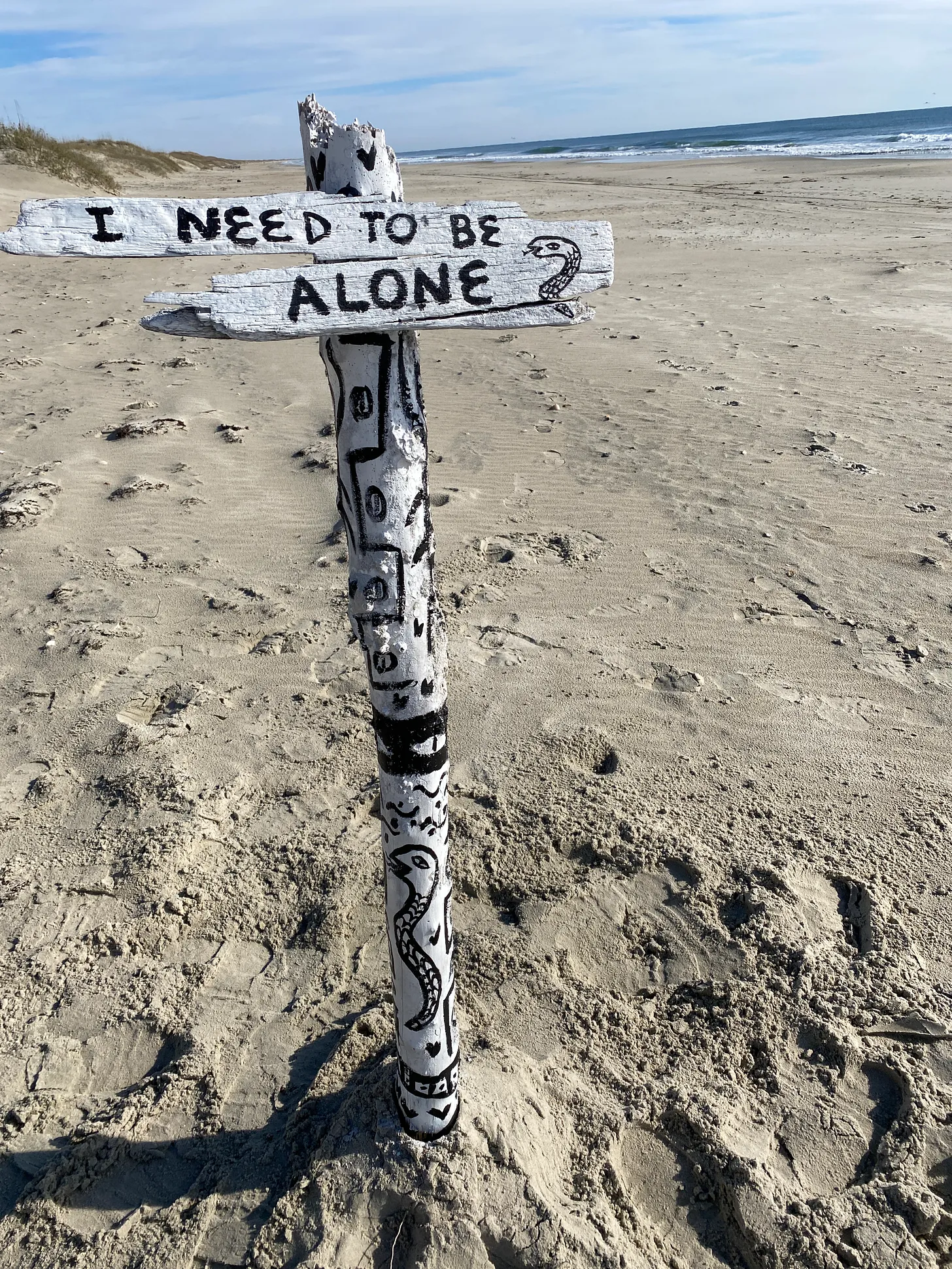
I felt terribly down, lost and lonely. I know from past experience that when I feel these kinds of feelings, trying to fight or resist them only makes them more entrenched, and that the best thing I can do is move towards them. So I decided that I needed to feel even more lost and lonely and headed off on my weird bike to the remotest part of the beach, knowing it would be the furthest away from human beings that I could be. The beach was totally deserted and my only company was the crashing of the winter waves and the occasional passing pelican or dolphin. I hid my bike behind a sand dune and walked on, trying to stay close to what I was feeling in order to get to know it better. After a while I came across an interesting piece of driftwood and decided that it might be a nice thing to paint. A little further on I found a slim tree trunk and a sheltered place in the dunes where I could sit and work. I wanted to honour how I was feeling so I painted the words “I need to be alone” onto the driftwood before nailing it onto the tree trunk that I had decorated with little black and white shapes and creatures. I realised that I had created something akin to a totem of aloneness, a celebration of the experience of being alone, and I felt a little more connected with myself through the process of making it. I dug a hole, planted the totem in the sand in the middle of the beach and headed off to try and remember where I had left my bike.
I got to know the island a little better over the following few days and discovered that there was one bar that was open for a few hours each evening. As it was the only place to go, I decided to give it a visit. As soon as I opened my mouth to order a drink, the handful of locals present heard my accent and asked what I was doing on Ocracoke at this time of year. I told them I was an artist doing an art residency on the island for the month of January. One of the locals looked at me and, after a short pause, asked in a very serious sounding tone “Are you the one who left that thing on the beach?” My immediate thought was that I had done something wrong. Ocracoke is a nature reserve, and maybe my impromptu art installation was illegal or offensive. I reluctantly admitted that I had made it and was surprised when the man shouted to the others in the bar, “Hey, this is the guy who made the thing on the beach! We love it. It is all over the Ocracoke Facebook group.”
And from that point on, everything changed. I got to know the locals in the bar and they got to know me as the British artist who made things out of driftwood. Many of the locals worked in the one shop on the island or in the couple of eateries that were open, so I started to get to know people outside of the bar too. I let go of the need to use any of the art materials and simply visited the beach each day with my black and white paints to see what the ocean had left for me to work with. Some days there was nothing, which I took as a sign to take a day off. Some days there were huge pieces of wood that took me most of the day to decorate. I even found an old cigar box that I turned into a geocache-style bit of buried treasure, with some cryptically painted signs (also driftwood) hinting at the location.
When Jo arrived on the island we continued to make all sorts of art from things that we found, which connected us with even more locals. We ended up meeting one of the presenters from Ocracoke Community Radio who invited us both to appear on his show. As a result of this, we met a local journalist who wrote a two-page article about us for the Ocracoke Observer website and the subsequent newspaper.
On the 31st January we left Ocracoke to begin the very long return journey and the whole experience of the last month started to feel like a strange dream. I had run out of house-sitting properties by this point, so I moved straight into my rented flat and began to reflect on what that last month had been about. What I kept coming back to was the experience of that initial day on the beach and making the totem of aloneness. It struck me that by moving towards the things I was trying to get away from - feeling lost, lonely and disconnected - I had discovered company and connection in spontaneous, organic ways that were much more exciting than any formal introductions that Jim could have made in advance.
I’m fascinated by the difference between aloneness and loneliness. I have a real need for self-regulating alone time, but I also know that, very suddenly, this can tip into feeling lonely and I don’t fully understand what causes this shift. Psychologists have long argued that our experience of loneliness evolved as a warning signal, indicating that important social needs are not being met, and prompting us to change our behaviour in the same way that hunger motivates us to seek food. In fact, some neuroscientists have suggested that loneliness may function as a form of “psychological hunger” – a biological signal, similar to hunger or thirst, that motivates us to seek connection for survival.
But whilst I like this concept, I still don’t fully understand what it is that satisfies this psychological hunger when I can be sitting in exactly the same room, yet oscillate between feeling peacefully alone and painfully connection-starved. In their 1981 research, Perlman and Peplau defined loneliness as the gap between the social connection we want and the connection we feel we have. In other words, when aloneness is voluntary it can result in an experience of calm and self-regulating solitude. But when it feels imposed or unwanted it can mutate into dysregulating loneliness.
Philosopher Hannah Arendt offers a deeper perspective on this. She makes a distinction between solitude and loneliness. For Arendt, solitude is being “two in one” with oneself – being objectively alone but still in dialogue and in deep contact with our inner experience (I use the word dialogue to mean a kind of connection that includes language, but also emotions, senses and sensations.) Arendt goes on to suggest that loneliness results from the loss of that internal dialogue and deep contact with our being. This means that, regardless of whether we are physically alone or not, this disconnection from our here-and-now experience can result in a sense of emptiness or alienation where we feel that we do not belong anywhere, not even in ourselves
But the bit that really excites me about Arendt’s work is her thoughts on the paradoxical nature of all of this: that intentionally practising solitude can actually protect against loneliness. This helps me make sense of my early Ocracoke experience. By intentionally moving into the empty, desolate landscape, far away from other humans, I entered a space where aloneness was simply the condition of the environment, softening the experience of loneliness into solitude. Finding the materials and becoming immersed in making the totem helped restore that “two-in-one” relationship with myself. The process of making it became a kind of non-verbal dialogue in which I was both listening to and responding to my here-and-now experience, eventually resulting in a physical artefact.
Placing the artwork on the deserted beach then formed a kind of social bridge between me and the Ocracoke community who remained on the island during the cold winter months. By moving intentionally towards solitude, I had unintentionally found connection.
NOTE: For those of you wondering what happened to the art materials that initially sat on the table tormenting me, we donated everything we didn’t use to the island’s school.

 Apple
Apple Spotify
 Pocket casts
 Youtube
 Audible
 Substack