Creative Adventures - podcast and Substack newsletter logo
Open windows into your world - an essay by @stevexoh

Opening windows into your world
by Steve Xoh

I recently re-published an old article entitled “Four lightly held philosophies for living a creative life”. One of the philosophies in this article was "Open windows into your world."

Lots of people said that the windows philosophy was the most exciting and helpful but also the most challenging. Many said that they found it hard to think beyond digital windows like websites and social media posts. I found this really interesting and it got me thinking about the weird, somewhat paradoxical stuckness that the digital age has created. There is an abundance of digital platforms, used by millions, on which we can share our work with the entire world (in theory) but, at the same time, this abundance has potentially limited our imagination when it comes to thinking of other, more traditional ways of sharing our work. Many of us end up in a frustrating, demotivating stuck pattern where we try even harder to come up with ways of making the digital windows work for us whereas the answer maybe lies in ignoring it all together. Or at least weaning ourselves off of it a little.

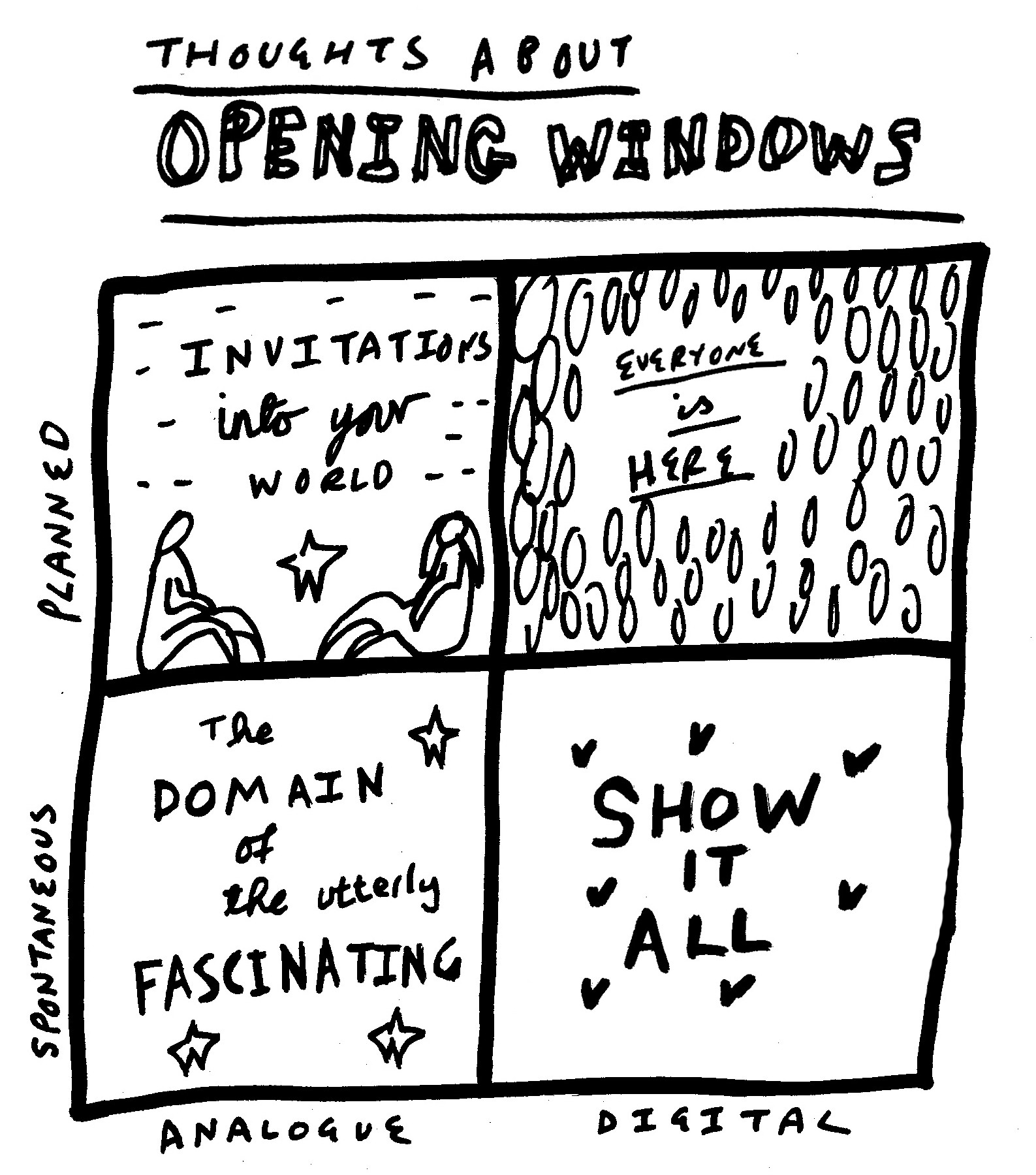
In the conversations I had with people about this on the back of the article, I found myself thinking that digital windows should be our last resort, or at least a less important of our practice. Instead it feels more helpful to focus our time and energy on experimenting with more spontaneous analogue windows. I drew a little four box grid to explore this.

Now this isn’t a well thought through theory beyond the 3 minutes it took me to draw it. And I’m not even sure if the four box grid makes sense, but for me it offers an invitation to disrupt my habitual thinking, provoke my imagination and encourage experimentation. If there is any theory behind it then it is this: analogue encounters are far more intriguing and fascinating windows into the world of others. I’m more likely to look at and remember at a weirdo doing something unusual and creative in a park than I am from seeing a photo on Instagram, a video on Tik Tok or visiting a website. And, in my experience, the more spontaneous and unplanned the experiment is, the more alive and “real” it feels in a way that makes it even more compelling.

My globally viral “(Not a) Lost Cat” project began as a spontaneous analogue experiment. I was bored one day and, inspired by a real lost cat poster, I painted my own fake one. A few days I later put up 10 copies of the poster in central London for no reason other than I thought it would be an interesting thing to do. These posters proved fascinating to people who saw them and many got in contact asking if they could have one to put up somewhere and, to cut a long story short, over 5,000 of these posters ended up being put up in 56 countries on every single continent (including Antarctica). The “(Not a) Lost Cat” project became a massive window into my world and lead to people buying art from my shop, contacting me about projects and workshops and inviting me to do talks about it all. (It was also featured in national newspapers, national radio and on a plethora of blogs across the internet). I subsequently used social media and my website to nurture and support the project’s growth but it all started from the seed of a spontaneous, analogue window into my world from 10 cheap posters I put up in London. (You can read the full story of the (Not a) Lost Cat project here)

Similarly, stick painting in the park was a spontaneous, analogue thing that I did in the spur of a moment because I was feeling low, had little money and was house-sitting next to a park with a load of sticks in it. In the end it proved to be an important window into my world that connected me with strangers and people who would become followers, friends and collaborators. I suspect that had I planned an instagram post or website page about stick painting or the (Not a) Lost Cat project in advance of just doing them then it wouldn’t have unfurled in the same way. I simply used the digital platforms to amplify and grow what had emerged spontaneously from “real world” encounters with my work.

I’m tempted to write more about all of this and explore my grid further but I think I would end up over-explaining it and drain the mystery out of it all. Also, I really don’t have any answers to any of this as I am constantly working it out for myself. I offer this little response to your questions and comments as a way of hopefully simultaneously helping whilst confusing further.

I’m doing a “Paint sticks in the park with stevexoh” thing on the 23rd August if you’d like to come and join me. (A planned, analogue window that emerged from the spontaneous one a few years back). If you’d like to come along you can find out more info here and get a free ticket/donation ticket HERE.

Please do keep writing to me with questions, comments and ideas for things you would like me to explore in future issues. The idea of this substack becoming a two-way conversation is exciting to me.

This essay was originally published on Substack. You can listen to the podcast in which Steve talks about this essay via the listening links below.

Opening windows into your world
by Steve Xoh

I recently re-published an old article entitled “Four lightly held philosophies for living a creative life”. One of the philosophies in this article was "Open windows into your world."

Lots of people said that the windows philosophy was the most exciting and helpful but also the most challenging. Many said that they found it hard to think beyond digital windows like websites and social media posts. I found this really interesting and it got me thinking about the weird, somewhat paradoxical stuckness that the digital age has created. There is an abundance of digital platforms, used by millions, on which we can share our work with the entire world (in theory) but, at the same time, this abundance has potentially limited our imagination when it comes to thinking of other, more traditional ways of sharing our work. Many of us end up in a frustrating, demotivating stuck pattern where we try even harder to come up with ways of making the digital windows work for us whereas the answer maybe lies in ignoring it all together. Or at least weaning ourselves off of it a little.

In the conversations I had with people about this on the back of the article, I found myself thinking that digital windows should be our last resort, or at least a less important of our practice. Instead it feels more helpful to focus our time and energy on experimenting with more spontaneous analogue windows. I drew a little four box grid to explore this.

Now this isn’t a well thought through theory beyond the 3 minutes it took me to draw it. And I’m not even sure if the four box grid makes sense, but for me it offers an invitation to disrupt my habitual thinking, provoke my imagination and encourage experimentation. If there is any theory behind it then it is this: analogue encounters are far more intriguing and fascinating windows into the world of others. I’m more likely to look at and remember at a weirdo doing something unusual and creative in a park than I am from seeing a photo on Instagram, a video on Tik Tok or visiting a website. And, in my experience, the more spontaneous and unplanned the experiment is, the more alive and “real” it feels in a way that makes it even more compelling.

My globally viral “(Not a) Lost Cat” project began as a spontaneous analogue experiment. I was bored one day and, inspired by a real lost cat poster, I painted my own fake one. A few days I later put up 10 copies of the poster in central London for no reason other than I thought it would be an interesting thing to do. These posters proved fascinating to people who saw them and many got in contact asking if they could have one to put up somewhere and, to cut a long story short, over 5,000 of these posters ended up being put up in 56 countries on every single continent (including Antarctica). The “(Not a) Lost Cat” project became a massive window into my world and lead to people buying art from my shop, contacting me about projects and workshops and inviting me to do talks about it all. (It was also featured in national newspapers, national radio and on a plethora of blogs across the internet). I subsequently used social media and my website to nurture and support the project’s growth but it all started from the seed of a spontaneous, analogue window into my world from 10 cheap posters I put up in London. (You can read the full story of the (Not a) Lost Cat project here)

Similarly, stick painting in the park was a spontaneous, analogue thing that I did in the spur of a moment because I was feeling low, had little money and was house-sitting next to a park with a load of sticks in it. In the end it proved to be an important window into my world that connected me with strangers and people who would become followers, friends and collaborators. I suspect that had I planned an instagram post or website page about stick painting or the (Not a) Lost Cat project in advance of just doing them then it wouldn’t have unfurled in the same way. I simply used the digital platforms to amplify and grow what had emerged spontaneously from “real world” encounters with my work.

I’m tempted to write more about all of this and explore my grid further but I think I would end up over-explaining it and drain the mystery out of it all. Also, I really don’t have any answers to any of this as I am constantly working it out for myself. I offer this little response to your questions and comments as a way of hopefully simultaneously helping whilst confusing further.

I’m doing a “Paint sticks in the park with stevexoh” thing on the 23rd August if you’d like to come and join me. (A planned, analogue window that emerged from the spontaneous one a few years back). If you’d like to come along you can find out more info here and get a free ticket/donation ticket HERE.

Please do keep writing to me with questions, comments and ideas for things you would like me to explore in future issues. The idea of this substack becoming a two-way conversation is exciting to me.

This essay was originally published on Substack. You can listen to the podcast in which Steve talks about this essay via the listening links below.

(C) Stevexoh 2025