When I started writing this Substack exactly a year ago, I became so immersed in the process that I had often completed the next issue within a few days of the previous one going out. I was so excited about sharing what I had written that it took a lot of discipline not to send it out straight away and instead wait until four weeks had passed to keep the regular rhythm going.
But my experience over the last few issues has felt noticeably different. I still have as many ideas for things I want to write about, and I still absolutely adore the writing process, but something subtle seemed to be shifting in my relationship with it all. I found myself putting off starting an issue until less than a week before it was due to go out and, on some occasions, finishing it the day before publication. This became even more time-pressured as I then had the podcast version to record, edit, master and upload.
I decided to spend some time this month reflecting on all of this and came to the conclusion that I had somehow accidentally turned the once-exciting process of writing into too much of a routine for it to remain as exciting as it originally was. The tiniest morsel of it beginning to feel like “work” had started to creep in, so I concluded that now was the time to experiment with disrupting it.
This whole thing started somewhat by accident. I had written a Mailchimp newsletter for around fifteen years, a sporadic thing that listed the workshops and events I had coming up, along with other bits of news I thought people might be interested in. But as the years went by, Mailchimp became more and more expensive and seemed to add endless features that I never used, so I decided to switch to Substack. I noticed that many people were using it less as a newsletter platform and more as a home for long-form writing, so it felt like a good opportunity to start writing longer pieces based on whatever had captured my interest over the previous month. I then accidentally launched a podcast in the process of trying to make an accessible audio version of it all.
Back then, there was no routine as I was making it up as I went along. But over time a routine for creating the Substack and podcast has emerged: 1) I collect thoughts and ideas for the next issue in my phone’s notes app, 2) I pick three of these and write the pieces that end up in the Substack, 3) I use the content of the Substack as a framework for recording the podcast and 4) I release it all into the wild every four weeks. And this routine has worked well for me. I’ve loved writing the 13 issues so far, the audience continues to grow and I’ve had some lovely feedback. So at some level, it feels ridiculous that I want to change something. But my intuition, and previous experience of similar things, tells me that I need to disrupt my own process in order to re-access the excitement and naivety I felt at the start, otherwise I suspect I’ll have run out of momentum and interest by issue 20.
Gordon MacKenzie tells a wonderful story in “Orbiting the giant hairball” about developing a creative workshop for managers at Hallmark Cards. Recalling the pitch he gave to management before running the first session, he writes: “[The workshop]… is called ‘Grope’. The object would be to expose the participants to a three-hour bombardment of non-rational experiences that would leave them wondering, ‘What the hell was all that about?’” Gordon ran the workshop and it was a huge success. Despite its bizarreness, it received great feedback. He was asked to run it a second time, and then a third, but each time he noticed that something important was missing.
Reflecting on this, he wrote: “In our first Grope session, because we had been willing to flow without structure, we opened ourselves to the creative energy that is extruded from chaos. I took that formula to a second workshop where, consequently, the experience became structured, linear… formulary rather than seminal. I was no longer facilitating a Grope session; I was conducting a Rote session.”
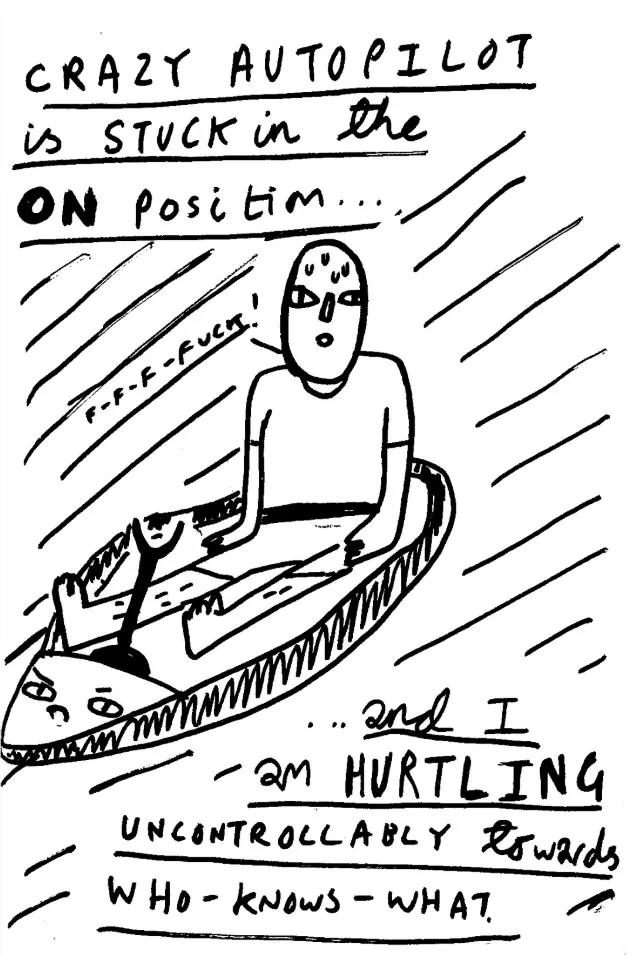
I realised that perhaps my changing relationship with this Substack was because I too had moved from grope to rote. So for this issue I experimented with moving back towards my own version of grope. As a reader, you may notice nothing different. But for me it has made creating this issue the most exciting and immersive one yet. Instead of sitting down to write, I went out on my kayak to a stretch of the River Thames I had never paddled before and recorded a flow of consciousness onto my Tascam audio recorder. (Which I accidentally dropped in the river, causing the screen to stop working so I had no idea whether it was recording or not.) I then turned this audio into a very raw and unpolished podcast episode and listened back to it in order to tease out the themes for writing this Substack. And here we are.
One of the magical things I discovered about starting in this way was that “writing” whilst doing a repetitive motion, in this case paddling the kayak, seemed to give me access to a much richer flow of spontaneous thought. It reminded me of a great exercise that theatre director Keith Johnstone once taught us. Keith would invite us up on stage to perform a repetitive task, such as miming washing up, whilst having a spontaneous conversation with another improviser. He was keen to point out that, in real life, people washing up would not talk about washing up itself (e.g. “Now I am washing up a plate”) but would either talk about something entirely unrelated or be in silence. It was a wonderful way of bringing the body into the experience of the improviser, one that seemed to disturb the internal censor just enough to allow a more natural and free-flowing chain of thought to emerge.
I had this experience in mind when James Traeger told me he wanted to give a talk on tennis at my experimental Inexpert conference, where people were invited to speak on subjects they had little or no expertise in. I suggested that, whilst James gave his talk, I would bounce tennis balls at him for him to serve back, and he sportingly agreed. It ended up being one of the highlights of the conference because not only was he talking about something he didn’t know much about, but his chain of thought was continually interrupted by the repeated physical action of having to hit the tennis balls. The result was a deeply human and beautifully imperfect talk.
But even though I have thoroughly enjoyed the strange and experimental process of writing this issue, I feel somewhat ashamed to admit that it does feel risky. And if I am completely honest, the entirety of that risk is to do with whether you, the reader, will reject it in some way. I have spent a lot of time writing these and slowly building a lovely audience for both the Substack and the podcast. That audience continues to grow each month, so part of me is screaming that this is not the time to start messing with a successful formula. I genuinely write this Substack for me because it helps me make sense of my experience and bring meaning into my life, but as all the risks I am feeling right now seem to be about losing audience, I realise that perhaps this has become more about numbers, stats and followers than I would like to admit. And this is something I want to gently let go of so that I can fully reconnect with the original spirit of it all.
A degree of unfamiliarity is important in my own creative practice and, I think, the process of writing this and recording the podcast has inevitably become more and more familiar over time. Philosopher and writer Rachel Jones, drawing on the work of Luce Irigaray, writes: “When we seek to make the strange familiar, we avoid the problem of meeting with the stranger… we avoid letting ourselves be moved, questioned, modified and enriched by the other. Part of the artistic work of becoming lies in remaining open to the strange in its strangeness; being prepared to lose ourselves in the encounter; risking not knowing as the condition of possible transformation.”
So, with the greatest respect for you as a reader, I realise that what you think of all of this and how you respond to it is of far less importance than the wonderful experience I had of making it and reconnecting with the original fizz and excitement of not really knowing what I am doing.

 Apple
Apple Spotify
 Pocket casts
 Youtube
 Audible
 Substack