Creative Adventures - podcast and Substack newsletter logo
Iridescent corvid secrets -an essay by @stevexoh

Iridescent corvid secrets
by Steve Xoh

One of the things I enjoy most about writing thiese articles is that people send me things. Often this takes the form of an email or a DM on social media sharing an interesting fact or bizarre story, but occasionally I’ll receive a physical object in the post. And because so much of what I write centres around my various creaturely obsessions, a lot of what I receive reflects that. I’ve learnt a lot about jays, and where to find them, from someone who is an expert. I get sent crab facts and photos of crabs that people around the world have encountered. And recently, I was sent a physical book that I now treasure as a kind of sacred object for many reasons.

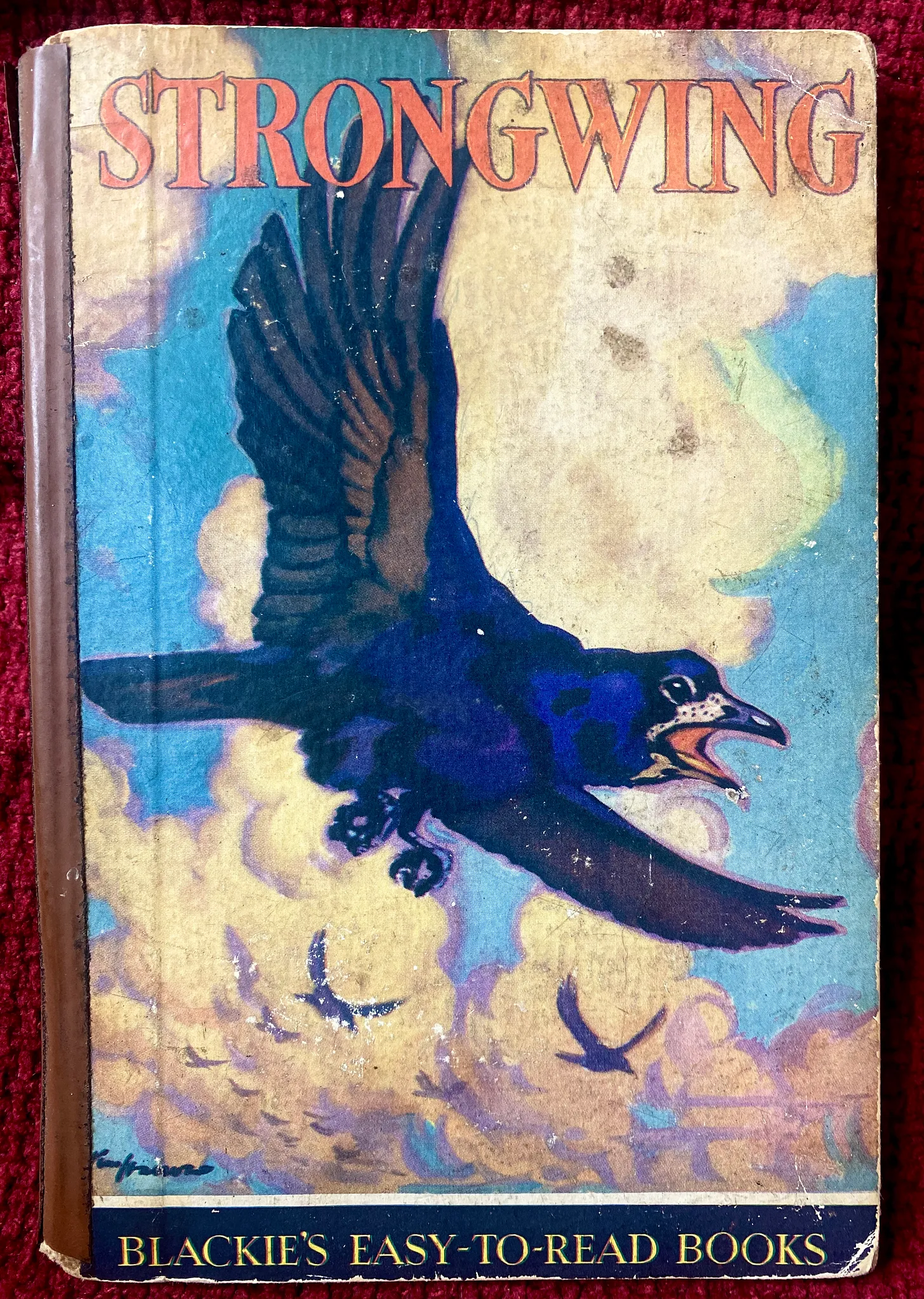
The book is an old children’s book called “Strongwing”. It is a story about rooks, but that’s only one of the reasons I love it. The cover is fascinating, especially for a children’s book, as the rook depicted on it looks slightly terrifying and is a strange mix of black, purple and blue. Inside, the sense of wonder continues with a series of slightly odd illustrations alongside the largest font size I think I’ve ever seen. But what I love most is how the life of the book itself seems to tell a parallel story.

In the inside cover is sticker that reads:

London County Council
Awarded to John O’Neill
St Mary’s Boy’s School for progress in reading.
July 1953

Somebody has carefully coloured in the strange black and white illustrations using coloured pencils. I have no idea if this was John O’Neill or a subsequent owner of the book, which makes me wonder how many hands it has passed through in the 73 years since it was presented as an award. (I can’t help but wonder if it was handed out in a school assembly or in a classroom, how John felt to receive it, and whether he was a nature nerd who loved it or thought it was a bit rubbish and worried it might ruin his tough image.) The book itself is a fascinating read. Rooks are one of my favourite birds, so I’m invested in the storyline whatever happens. But what I found most interesting is how it offers a glimpse into 1950s life, and what it reveals about the culture of the UK at that time.

There are lots of subtle messages woven through the story about strength and status. A sense that being better than others, rising to the top and becoming admired by all, is what one should aspire to. There are also some interesting gender dynamics, even in the corvid world: “Oh dear! You must be careful because you are not as strong as me. The wind could not blow me off the tree, I am much too strong.” (Strongwing talking to a female rook he has just met. This is a theme that continues throughout) It made me wonder how much of this was intentional, and how much simply reflects the culture of the time in which the book was written. Either way, it feels like there are layers in here that extend far beyond a simple children’s story.

But it was another recent “gift” that captivated me and led me down a creaturely rabbit hole. I received a message from someone who told me that the number-one animal fact in their household was that crows are actually rainbow coloured. My immediate thought was noooo, that’s not true, and I assumed it was a child’s vivid imagination at work. But there was something about it that intrigued me, especially having spent a lot of time feeding Crow up close and noticing flashes of purple and blue on her feathers when the sun hits them at a certain angle. So I began to look into it and discovered that it is, in fact, somewhat true.

It all starts with the fact that birds have a different set of colour receptors, known as cones. Humans have three types of cones that detect red, green and blue and the combination of these creates the palette of colours that we experience. Most birds, on the other hand, have four cones that detect red, green, blue and, most importantly, ultraviolet. This means they can see colours that we don’t even know exist. On top of this, birds have oil droplets in their eyes that sit in front of each cone and filter the incoming light, increasing the precision of their colour detection. (The downside of this, and presumably one reason humans don’t have it, is that the oil reduces the amount of light entering the eye, meaning a bird’s vision is incredibly precise in daylight but less effective in low light.) And if this wasn’t enough, some birds also have light-sensitive proteins in their eyes called cryptochromes, which are thought to respond to light influenced by magnetic fields, potentially providing a kind of sat-nav-like overlay on top of this already brilliantly pimped-up vision.

So, taking all of this into account, whilst we can never know what a crow actually sees when it looks at another crow, it seems likely that they appear far more colourful to each other than they do to us. This makes me wonder if the strange bluey-purple hue of Strongwing on the cover of the book wasn’t, in fact, an accident, but a wise choice. It also raises the question of whether there is a different, hidden storyline in the book itself that is only visible to corvids. And maybe that’s also true of the everyday story we find ourselves in, that we’re moving through a world that is far more vivid than we’re able to perceive.

This essay was originally published on Substack. You can listen to the podcast in which Steve talks about this essay via the listening links below.

Iridescent corvid secrets
by Steve Xoh

One of the things I enjoy most about writing thiese articles is that people send me things. Often this takes the form of an email or a DM on social media sharing an interesting fact or bizarre story, but occasionally I’ll receive a physical object in the post. And because so much of what I write centres around my various creaturely obsessions, a lot of what I receive reflects that. I’ve learnt a lot about jays, and where to find them, from someone who is an expert. I get sent crab facts and photos of crabs that people around the world have encountered. And recently, I was sent a physical book that I now treasure as a kind of sacred object for many reasons.

The book is an old children’s book called “Strongwing”. It is a story about rooks, but that’s only one of the reasons I love it. The cover is fascinating, especially for a children’s book, as the rook depicted on it looks slightly terrifying and is a strange mix of black, purple and blue. Inside, the sense of wonder continues with a series of slightly odd illustrations alongside the largest font size I think I’ve ever seen. But what I love most is how the life of the book itself seems to tell a parallel story.

In the inside cover is sticker that reads:

London County Council
Awarded to John O’Neill
St Mary’s Boy’s School for progress in reading.
July 1953

Somebody has carefully coloured in the strange black and white illustrations using coloured pencils. I have no idea if this was John O’Neill or a subsequent owner of the book, which makes me wonder how many hands it has passed through in the 73 years since it was presented as an award. (I can’t help but wonder if it was handed out in a school assembly or in a classroom, how John felt to receive it, and whether he was a nature nerd who loved it or thought it was a bit rubbish and worried it might ruin his tough image.) The book itself is a fascinating read. Rooks are one of my favourite birds, so I’m invested in the storyline whatever happens. But what I found most interesting is how it offers a glimpse into 1950s life, and what it reveals about the culture of the UK at that time.

There are lots of subtle messages woven through the story about strength and status. A sense that being better than others, rising to the top and becoming admired by all, is what one should aspire to. There are also some interesting gender dynamics, even in the corvid world: “Oh dear! You must be careful because you are not as strong as me. The wind could not blow me off the tree, I am much too strong.” (Strongwing talking to a female rook he has just met. This is a theme that continues throughout) It made me wonder how much of this was intentional, and how much simply reflects the culture of the time in which the book was written. Either way, it feels like there are layers in here that extend far beyond a simple children’s story.

But it was another recent “gift” that captivated me and led me down a creaturely rabbit hole. I received a message from someone who told me that the number-one animal fact in their household was that crows are actually rainbow coloured. My immediate thought was noooo, that’s not true, and I assumed it was a child’s vivid imagination at work. But there was something about it that intrigued me, especially having spent a lot of time feeding Crow up close and noticing flashes of purple and blue on her feathers when the sun hits them at a certain angle. So I began to look into it and discovered that it is, in fact, somewhat true.

It all starts with the fact that birds have a different set of colour receptors, known as cones. Humans have three types of cones that detect red, green and blue and the combination of these creates the palette of colours that we experience. Most birds, on the other hand, have four cones that detect red, green, blue and, most importantly, ultraviolet. This means they can see colours that we don’t even know exist. On top of this, birds have oil droplets in their eyes that sit in front of each cone and filter the incoming light, increasing the precision of their colour detection. (The downside of this, and presumably one reason humans don’t have it, is that the oil reduces the amount of light entering the eye, meaning a bird’s vision is incredibly precise in daylight but less effective in low light.) And if this wasn’t enough, some birds also have light-sensitive proteins in their eyes called cryptochromes, which are thought to respond to light influenced by magnetic fields, potentially providing a kind of sat-nav-like overlay on top of this already brilliantly pimped-up vision.

So, taking all of this into account, whilst we can never know what a crow actually sees when it looks at another crow, it seems likely that they appear far more colourful to each other than they do to us. This makes me wonder if the strange bluey-purple hue of Strongwing on the cover of the book wasn’t, in fact, an accident, but a wise choice. It also raises the question of whether there is a different, hidden storyline in the book itself that is only visible to corvids. And maybe that’s also true of the everyday story we find ourselves in, that we’re moving through a world that is far more vivid than we’re able to perceive.

This essay was originally published on Substack. You can listen to the podcast in which Steve talks about this essay via the listening links below.

(C) Stevexoh 2025