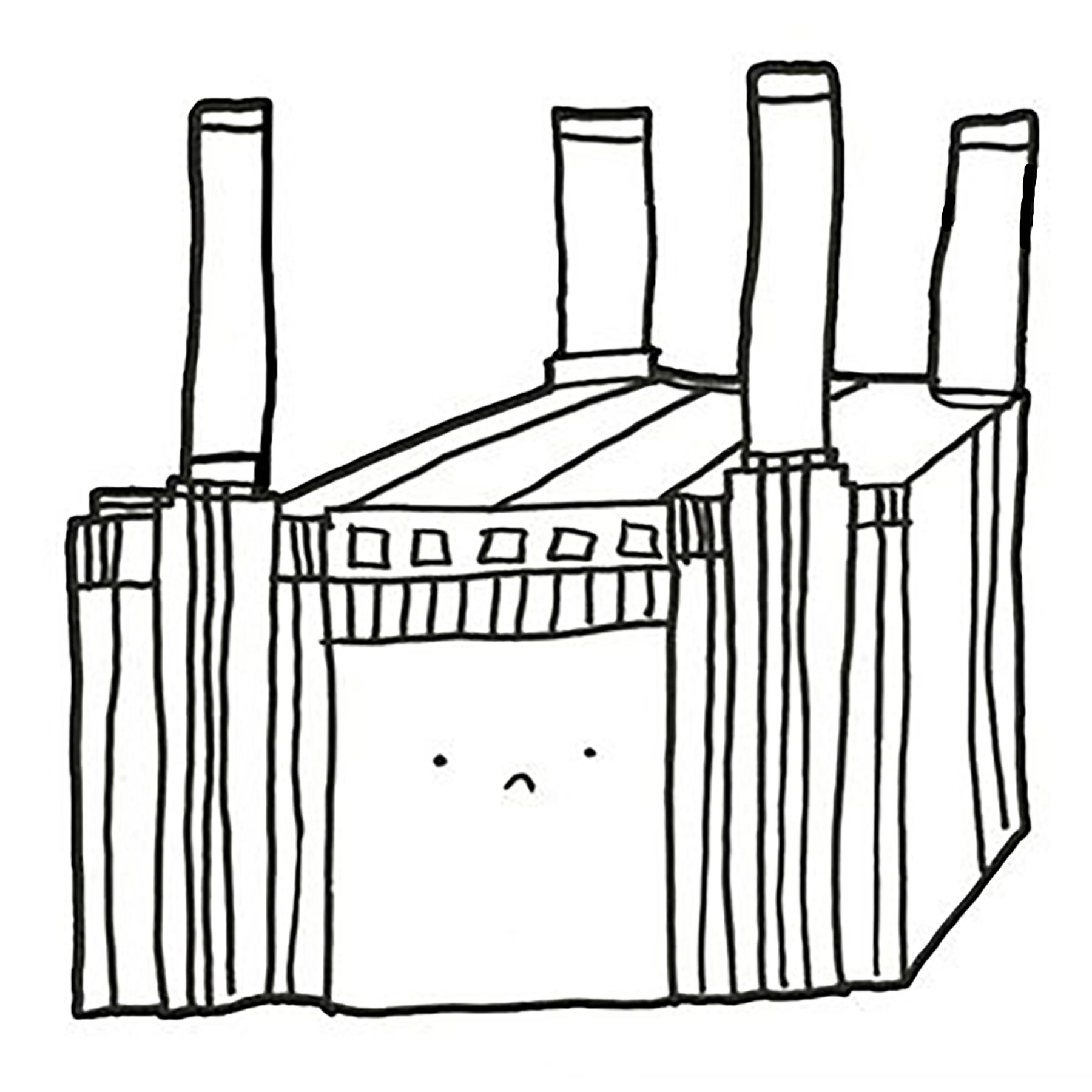
For as long as I can remember, Battersea Power Station has intrigued me. I recall passing it on the train as a child many times, struck not only by its size, but also by its solid, art deco industrial form. I’ve always wondered what it would be like to go inside this imposing, cavernous building. I have a vague memory of recurring dreams from childhood about vast brick structures, so there was something about the power station that both fascinated and unsettled me - something I could imagine experiencing as both awe-inspiring and overwhelming.
Construction of “Station A” began in 1929, with “Station B” completed in 1955, adding two more chimneys to create the now-iconic four-chimney structure. It was one of the largest coal-fired power stations in Europe and, at its peak, supplied around 20% of London’s electricity. After more than fifty years of operation, the station closed in 1983 due to the declining viability of coal-fired power generation, alongside its inefficiency and pollution relative to more modern oil, gas and nuclear alternatives. After decades of failed redevelopment attempts, the Grade II* listed building was eventually redeveloped by a Malaysian consortium and reopened to the public in 2022, breathing new life into this London landmark.
It was on one of my recent long Thames walks that I found myself passing the power station and realised that I could finally go inside. I imagined being awestruck as I entered the cavernous, slightly eccentric art deco, marble-floored turbine halls that had been historically described as cathedrals of power. But as I walked through the doors for the first time, I experienced an immense sense of disappointment and sadness. I found myself in a shopping mall. A shopping mall that looked like any other in the world. Low ceilings, fluorescent lights, generic stores. I decided I wanted to get out of this part as quickly as possible and find the old spaces, but I was trapped in a one-way route that meant the only way back to the entrance was to walk through more of the mall. After finding my way back outside, I was so discombobulated by the experience that I decided to just head home. I felt sad about the gap between what I had imagined and what I found. It felt like biting into a much-anticipated exotic fruit only to discover it had gone rotten in the middle. I spent the next few hours wondering why it had disturbed me in this way.
I have since found out that there are some areas of the building that are more reflective of the original space, but even these have had their openness broken up by new floors, escalators and mezzanines. The original openness has been subdivided, and even looking at photos of these areas leaves me with a sense that something essential has been lost. I recognise that part of this reaction is personal, shaped by my own attraction to empty spaces and large, abandoned industrial structures, but the way Battersea Power Station has been repurposed made me curious about what it says about modern society more broadly. It felt as though the soul of the building had been carved up and conveniently packaged into bite-sized chunks of commercial modernity. It’s true that the building was crumbling and falling into disrepair, so arguably this redevelopment saved it. But at what cost? And what does it say about society when the only way we can save something is by making it more like everything else, and entirely commercial?
The German philosopher Walter Benjamin wrote extensively about art, culture and modernity, and how mass reproduction can change our relationship to meaning and experience. One of his core ideas is what he calls a “loss of aura” - that when something is reproduced or standardised, it loses its unique, unrepeatable presence. He describes aura as an object’s “presence in time and space, its unique existence at the place where it happens to be”. When that uniqueness is eroded through repetition, standardisation and the norms of modern, commercial design, that aura begins to fade. Through this lens, the building of Battersea Power Station remains, but what constituted its presence has been fundamentally altered. The modernisation and subdivision of the space mean that the meaning we make of the building has irrevocably shifted. The place I imagined I would encounter with a sense of reverence and awe has been commoditised in such a way that it comes with its own instructions about what meaning I should make of it, rather than leaving that for me to uncover in my own way.
The anthropologist Marc Augé might describe the modern interior of Battersea Power Station as a “non-place” - a space that lacks identity, history and meaningful human connection. Non-places seem to be an inevitable byproduct of capitalism, where the unique meaning of an empty space is flattened as it is turned into something that can be compartmentalised, replicated and made to generate profit.
A similar pattern shows up in the natural world. Ecosystems thrive when they are allowed to remain messy and complex. When they are neatened and controlled for ease of human use, they tend to lose their natural diversity and vitality. I met the forester Jim Reilley a few years ago for the Glen Dye Podcast. He spoke about the art of forestry and the importance of forests being allowed to remain “biologically untidy”, as opposed to what he called “golf-course forests” - landscapes that have been artificially tidied for human ease. In nature, messiness equals diversity, and diversity equals resilience. By contrast, there is a fragility to monoculture, as it is far less able to adapt and respond to inevitable change.
And for me, this is also why our messy, “biologically untidy” creative self-expression matters. There is a constant pull to tidy it up, to make it more palatable and more easily consumed, but something essential and unique is lost in the process of doing so. In the same way that monocultures reduce resilience in nature, a kind of human monoculture begins to emerge when we all start to move towards replicable “golf-course creativity” because it fits more comfortably within the structures of a capitalist society.
What I experienced as absent in the interior of Battersea Power Station, and what often feels absent in many modernised spaces, is an invitation into awe and mystery. The sense of encountering something I don’t fully understand, and having to make meaning of it through my own imagination because of its utter uniqueness. And whether it is a building, a forest or our own way of making a mark in the world - when everything becomes more uniform, something essential disappears. It therefore feels vital to resist the pull towards a more normative form of creativity, and instead keep that sense of uniqueness alive through our own imperfect, uncensored creative expression.

 Apple
Apple Spotify
 Pocket casts
 Youtube
 Audible
 Substack