The warmer weather has brought more people to the places where I normally find stillness, silence and solitude. Whilst a selfish part of me would quite like these places to be available exclusively for my own escape from humanity, I recognise that they are important to many other people too. The thing I find difficult is not so much that other people are there, but the way in which they choose to be there.
I have a real sensitivity to noise. To be more precise, I have a real sensitivity to human-generated noise. Whilst I can take great pleasure in a terrifyingly loud thunderstorm or a cacophony of jackdaws on my windowsill, a TikTok video played on a phone 300 metres away can trigger an almost primal response in me. It can make me feel as though I either need to run away as fast as I can or grab the phone and throw it into the river/sea/off a cliff. Clearly, neither of these are healthy adult responses. So instead, I’ve found myself wondering why, when encountering the beauty and stillness of nature, people often seem compelled to fill the space with noise and distraction.
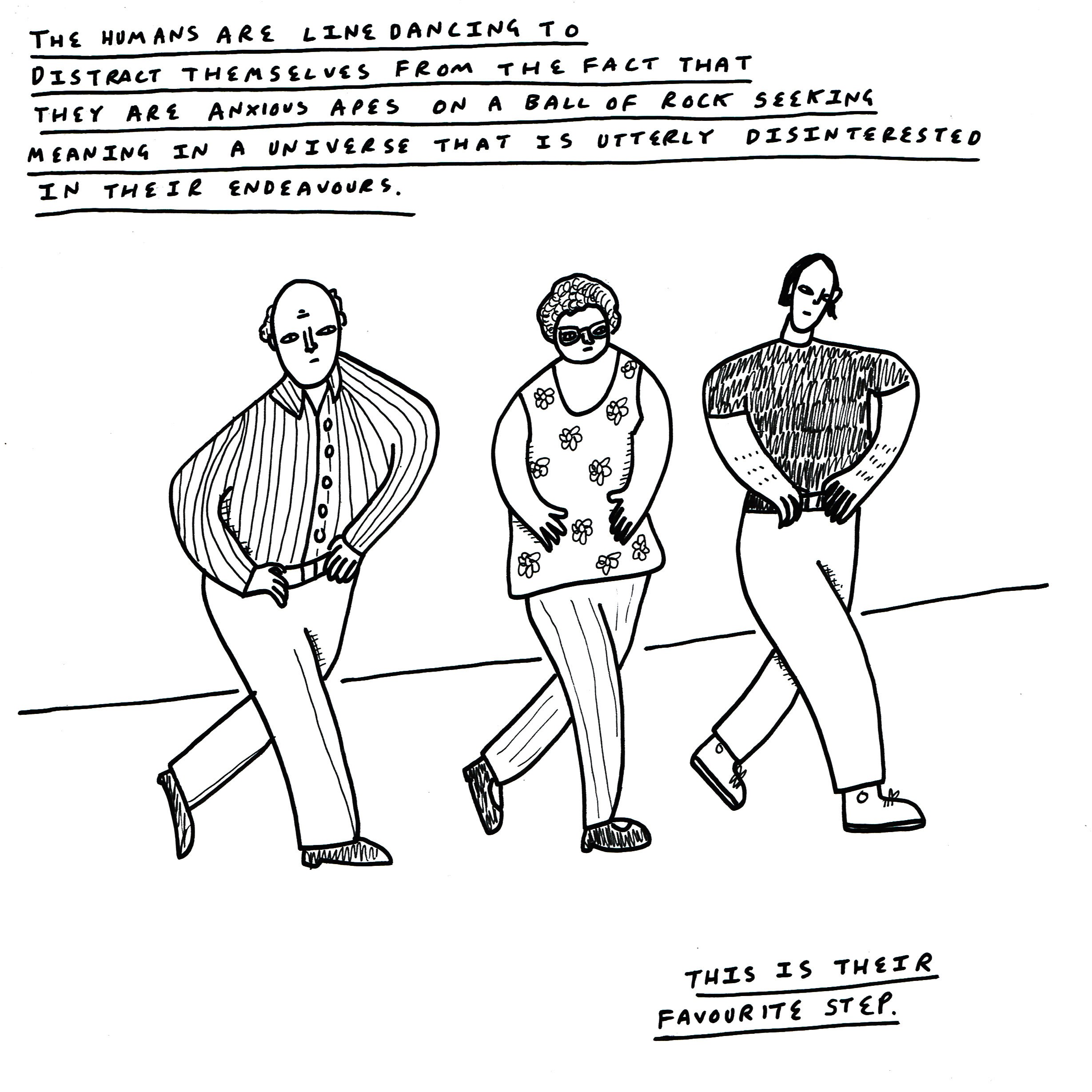
Many hundreds of years before the invention of our modern distractions, the 17th Century French philosopher Blaise Pascal observed: “I have often said that all the unhappiness of men arises from one single fact, that they cannot stay quietly in their own chamber.” Pascal was interested in understanding what he referred to as diversion. He believed that human beings are haunted by a number of uncomfortable realities: our mortality, our insignificance, uncertainty, suffering, loneliness and the fact that, when we think about it long enough, we realise we ultimately control very little. A diversion, therefore, was not necessarily valuable because of the activity itself, but because it distracted us from confronting these realities. This perspective helps me find a little more compassion when confronted with a boat full of noisy people drifting past with a very loud Bluetooth speaker as I try to sit quietly with my crow friends. Perhaps these people are not simply being inconsiderate but are simply doing their best to avoid spending too much time alone with their existential dread.
But whilst I like this hypothesis, I still feel like a somewhat dysfunctional and slightly malfunctioning creature when I react so viscerally to noise in nature. I want to better understand why so that I can take more responsibility for my part in it. The most obvious explanation is that, due to my poor sensory gating (the ability to tune out background noise), what others experience as mildly irritating can feel to me like an invasion of attention. I feel that I lose a sense of choice over the focus of my here-and-now experience, which can trigger a fight-or-flight response. But I also wonder whether there is something more going on than simple sensory sensitivity.
The philosopher Albert Borgmann wrote about the difference between experiences that invite our full participation and attention and those that simply provide us with a commodity to consume. Borgmann distinguished between what he called focal things and practices, which draw us into participation and relationship, and devices, which deliver a desired experience with as little effort or involvement as possible. Writing in the 1980s, he uses the example of the difference between building a fire and using central heating. Historically, keeping warm involved gathering wood, building and tending a fire, and sitting around it with others. The fire became a focal thing and the acts of gathering, tending and sharing its warmth became a practice.
The invention of central heating transformed this relationship. The outcome is essentially the same, we stay warm, but the activity itself has been outsourced to a device. What was once a focal thing and practice is now largely hidden from view, with warmth arriving at the touch of a button and regulated by a thermostat. What was once foreground in our experience now fades into the background.
This makes me wonder whether part of my reaction to loud music in nature is that nature itself has become a focal thing for me, a place of quiet solitude that feels almost like a sacred sanctuary and is essential for my self-regulation. Perhaps the music feels so jarring because it redirects my attention away from the natural world and towards somebody else’s chosen experience. This doesn’t necessarily mean one approach is right and the other wrong (even though I really want to say that of course it is!) It may simply be a clash of values and different strategies for meeting human needs. I seek immersion, stillness and a sense of encounter to self-regulate, whilst others may be seeking connection, celebration, stimulation or escape to achieve the same outcome.
I’m left wondering whether modernity has resulted in nature becoming a device in many of the situations I am describing. A backdrop to our experience rather than the focus of it. Perhaps stillness and solitude have become commodities, blank canvases that feel too irresistible to leave unfilled. So we reach for noise, distraction and stimulation to fill them. Not to encounter the world around us, but to escape ourselves. And in doing so, we risk missing the mysteries that nature is quietly whispering to us.

 Apple
Apple Spotify
 Pocket casts
 Youtube
 Audible
 Substack