Creative Adventures - podcast and Substack newsletter logo
Grebo Guru

The invention of memory
by Steve Xoh

This Substack recently turned one and I inevitably found myself reflecting on what was happening in my life a year ago when I decided to start it. What was I thinking and feeling? What was occupying my mind? What was I excited about or anxious about? And what was going on in the world around me? But the more I reflected on all of this, the question that really began to fascinate me was where on earth I was retrieving all of these memories from.

I read a book called The Invention of Memory by Israel Rosenfield many years back and, ironically, had forgotten all about it until this moment. In the book, Rosenfield suggests that memories are not fixed representations of past events stored somewhere in the brain waiting to be retrieved, but are actively constructed in the present from the neural traces those experiences have left behind. Remembering is therefore less like replaying a recording and more like creating something new each time, shaped by our current context, emotions and everything that has happened to us since. This means that remembering is not a reliable window into the past, but a new experience created in the present that is unavoidably influenced by who we are now. But even though the act of remembering is a very here-and-now experience, we seem to find this incredibly difficult to conceive of, preferring instead to imagine memory as a load of stuff stored somewhere that we can retrieve.

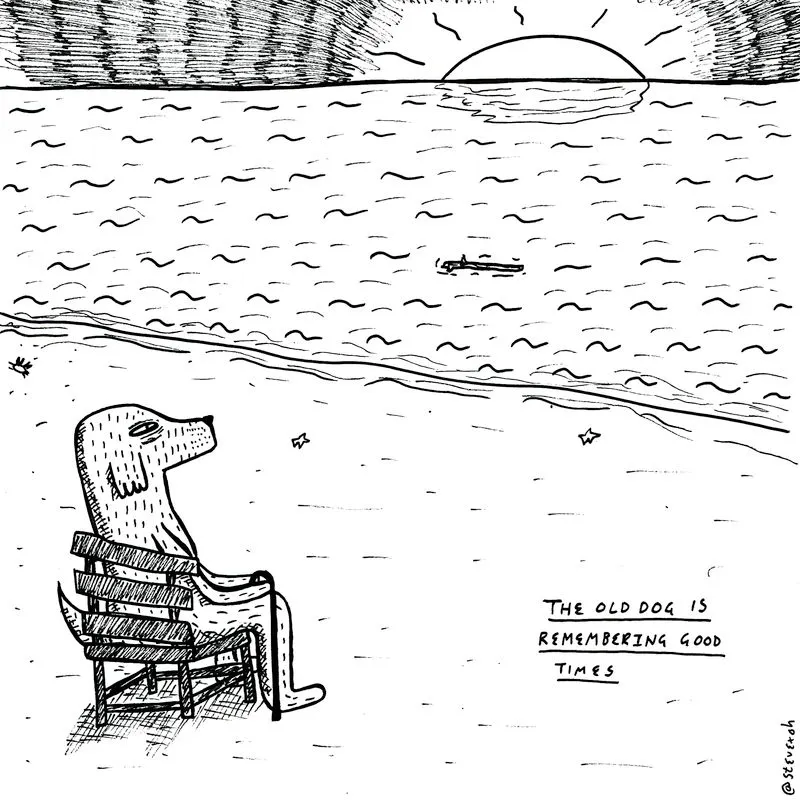
What I find extra fascinating about all of this, is how human beings’ perception of memory has been shaped by the world around us and, in particular, the technology we have created. In a world of digital cloud storage, it is easy to think of memory as a vast database we can interrogate or access. But go back 30 years, when this technology didn’t exist, and the metaphor of the VHS video recorder greatly informed how we conceived of memory. As we trace back through history, we can get a sense of how the invention of photography, the printing press and the manuscript helped us make sense of this mysterious human experience of time travel. Even in ancient Greece, Plato suggested that memory was like a wax block in the soul in which impressions were left through our experiences. But, given what we now understand about the reconstructive nature of memory, all of these metaphors seem fundamentally flawed. Memory, it seems, is more like looking at the sea. We recognise it as the same sea each time we look, despite the fact that what we are actually experiencing is being created anew in that particular moment.

This brings to mind various occasions when my daughter told me of memories she has of things we did together when she was a young child, but I recall them very differently. It is tempting to say, “That’s not what happened”, but I’m now more wary of writing off our different recollections given that we are not accessing a concrete archive, but re-creating an experience in the moment. I recall similar things with my parents. I remember a number of occasions when my dad insisted that I had a crush on the Pretenders’ singer Chrissie Hynde when I was young. I have no recollection of that whatsoever and, whilst I remember finding people on the television attractive, I cannot find any trace of having those kinds of feelings directed towards Chrissie!

So, given how memory is essentially a present-moment experience, I’m left wondering what on earth the difference is between memory and imagination. Neuroscientists Donna Addis and Daniel Schacter proposed that remembering and imagining use substantially overlapping cognitive circuitry. Live and in the moment, we are able to reconstruct elements of past experiences as memories, or recombine those same elements into events that have never happened as imagination. Addis describes this shared underlying process as “constructive episodic simulation”.

Normally when I write this Substack, I like finding a way to go down a rabbit hole to explore things like this, cracking my mind open in the process but then finding a nice way to tie it all up to finish the piece. But I am stumped with this one as it has spawned so many sub-rabbit holes and makes me question, in a deeply curious way, how inaccurate my experience of anything other than the present moment might be. And, paradoxically, maybe that is the conclusion: to accept the flaws, inaccuracies and uncertainty inherent in our temporal human experience, be that how we remember the past or imagine the future.

Friedrich Nietzsche believed that forgetting wasn’t a failure of memory but an active and necessary human process that created room for something new. He suggested that “life in any true sense is absolutely impossible without forgetfulness”, implying that without forgetting we couldn’t properly inhabit the present at all. I like that, but also wonder if somehow his imagination had been overly influenced by the yet-to-be-invented metaphor of cloud storage capacity.

This essay was originally published on Substack. You can listen to the podcast in which Steve talks about this essay via the listening links below.

The invention of memory
by Steve Xoh

This Substack recently turned one and I inevitably found myself reflecting on what was happening in my life a year ago when I decided to start it. What was I thinking and feeling? What was occupying my mind? What was I excited about or anxious about? And what was going on in the world around me? But the more I reflected on all of this, the question that really began to fascinate me was where on earth I was retrieving all of these memories from.

I read a book called The Invention of Memory by Israel Rosenfield many years back and, ironically, had forgotten all about it until this moment. In the book, Rosenfield suggests that memories are not fixed representations of past events stored somewhere in the brain waiting to be retrieved, but are actively constructed in the present from the neural traces those experiences have left behind. Remembering is therefore less like replaying a recording and more like creating something new each time, shaped by our current context, emotions and everything that has happened to us since. This means that remembering is not a reliable window into the past, but a new experience created in the present that is unavoidably influenced by who we are now. But even though the act of remembering is a very here-and-now experience, we seem to find this incredibly difficult to conceive of, preferring instead to imagine memory as a load of stuff stored somewhere that we can retrieve.

What I find extra fascinating about all of this, is how human beings’ perception of memory has been shaped by the world around us and, in particular, the technology we have created. In a world of digital cloud storage, it is easy to think of memory as a vast database we can interrogate or access. But go back 30 years, when this technology didn’t exist, and the metaphor of the VHS video recorder greatly informed how we conceived of memory. As we trace back through history, we can get a sense of how the invention of photography, the printing press and the manuscript helped us make sense of this mysterious human experience of time travel. Even in ancient Greece, Plato suggested that memory was like a wax block in the soul in which impressions were left through our experiences. But, given what we now understand about the reconstructive nature of memory, all of these metaphors seem fundamentally flawed. Memory, it seems, is more like looking at the sea. We recognise it as the same sea each time we look, despite the fact that what we are actually experiencing is being created anew in that particular moment.

This brings to mind various occasions when my daughter told me of memories she has of things we did together when she was a young child, but I recall them very differently. It is tempting to say, “That’s not what happened”, but I’m now more wary of writing off our different recollections given that we are not accessing a concrete archive, but re-creating an experience in the moment. I recall similar things with my parents. I remember a number of occasions when my dad insisted that I had a crush on the Pretenders’ singer Chrissie Hynde when I was young. I have no recollection of that whatsoever and, whilst I remember finding people on the television attractive, I cannot find any trace of having those kinds of feelings directed towards Chrissie!

So, given how memory is essentially a present-moment experience, I’m left wondering what on earth the difference is between memory and imagination. Neuroscientists Donna Addis and Daniel Schacter proposed that remembering and imagining use substantially overlapping cognitive circuitry. Live and in the moment, we are able to reconstruct elements of past experiences as memories, or recombine those same elements into events that have never happened as imagination. Addis describes this shared underlying process as “constructive episodic simulation”.

Normally when I write this Substack, I like finding a way to go down a rabbit hole to explore things like this, cracking my mind open in the process but then finding a nice way to tie it all up to finish the piece. But I am stumped with this one as it has spawned so many sub-rabbit holes and makes me question, in a deeply curious way, how inaccurate my experience of anything other than the present moment might be. And, paradoxically, maybe that is the conclusion: to accept the flaws, inaccuracies and uncertainty inherent in our temporal human experience, be that how we remember the past or imagine the future.

Friedrich Nietzsche believed that forgetting wasn’t a failure of memory but an active and necessary human process that created room for something new. He suggested that “life in any true sense is absolutely impossible without forgetfulness”, implying that without forgetting we couldn’t properly inhabit the present at all. I like that, but also wonder if somehow his imagination had been overly influenced by the yet-to-be-invented metaphor of cloud storage capacity.

This essay was originally published on Substack. You can listen to the podcast in which Steve talks about this essay via the listening links below.

(C) Stevexoh 2025